Content Archives | Spectrum Net Designs

2024 SEO Trends

2024 SEO Trends

As SEO keeps updating and changing we need to make sure that you don’t keep using the same old and outdated tactics that once worked. With the advancement of AI and technology that just means that seo marketing is changing faster than ever.

So, we are going to teach you 4 SEO trends that you should be up to date on to make sure that you won’t be left behind.

A person looking at a press release on an ipad

Ai Overview

Whether you like it or not ai is going to be a large part of the future of the world, not just SEO.

Google has even updated its policies to change from looking for high quality content made by people for people to content made for people. Now this might not seem like a large switch but what they are saying is they no longer care who/what (ai) makes the content as long as it is high quality.

They did this because they realized that they wanted to start taking advantage of the benefits of AI. But they very well can’t say well we can use AI content because it’s great, but you can’t because it isn’t high quality content. That’s like saying this food is so good and healthy but you can have any because it’s poisonous.

What to do

Now just because Google is giving people the answers without having to go onto websites doesn’t mean this is a bad thing.

An AI is only as smart as the info it has so focusing on creating high quality content is key because if Google is drawing information from different sources you want to make sure they see you as one of the leading authorities.

As you can see google is also showing down below where they got their data from, so people could click on you to get more info on their search.

So, our best recommendation is to keep putting out high quality content and make sure that it is data/information rich, so the Google AI bot will draw from you.

Answer Engine Optimization (AEO)

AEO also has to do with ai bots, and it is the prosses of optimizing your content and website to be usable by Ai’s like Chat GPT, Google SGE, and Grok.

Ai search engines are changing the way that people are looking for information. Because now people are just typing their questions into an ai to get their answers because it will look at multiple different sources and gives you an unbiased answer.

What we need to start learning how to do is make sure that these ai bots are pulling info from your website.

We know some people might say why would I want to ai to pull data from my site. The first reason is if I ask what are the best shoes for running?  You want the ai to say you should shop for shoes at nike.com if you are looking for running shoes. Another reason is when Googles and Bings bots use your site that means the search engines view you as authority on the topic and that is the main purpose of seo; to make search engines view you as an authority on a topic.

What To Do

There are a couple of different things that you need to start doing for answer engine optimization.

First, you need to start making your content easy to digest and understand. We know this is already something that you should already be doing, but it is now more important than ever. Your content needs to be super easy to understand so the AI can easily pull information from it.

Another great way to optimize is to include an FAQ section on your pages. You might say why I would need an FAQ page for AI. Well, it makes a ton of sense because what you are trying to do is mimic questions people might ask their AI. So, when the AI sees you answer the exact question that the user asked it will draw the info from your site.

Looking at a press release on a laptop

Focus on Topical Authority

Back in the day topical authority wasn’t that big of a deal, it was more based on your domain authority. If you had super high domain authority, you were able to rank well even if you don’t normally publish related content.

But now search engines are focusing more on your topical authority and what you are an expert on.

This is fantastic for us because most of us are smaller sites compared to Amazon and Apple. So, Google is filtering out some of the larger sites from the SERPs because they are only kind of related.

What To Do

The best way to keep building your topic authority is to keep pushing content that shows you are an authority on that topic.

You should be publishing everything you can think of about your category from super broad articles for the average person, and highly detailed articles for experts in the field. All of this will show that you are well versed in what you are talking about, and you can be trusted.

You should also only be posting related content on each site. For example, if you are an affiliate marketer and you want to try and market pet food and car parts you should have a different website. If you tried to put all of this on the same website Google would see this and get confused and wouldn’t see you as a professional because you are trying to be an expert on two completely different categories.

If you do want to promote both of these different things that’s not a problem, you just need two different websites. It is most definitely more work, but now since you are only focusing on one thing google will see each of your sites as an authority rather than just having one that’s not viewed as an authority on anything.

Evolving Search Engine Ranking Factors

Search engines are starting to prioritize your trustworthiness and expertise in the content you are providing. They are starting to give more precise answers from smaller websites showing you are larger website, but it doesn’t answer your questions.

Now this doesn’t mean that you can be super small either. You can’t have a super small website with a DR score of 0 even if you are answering the exact question.  Google won’t show your site because they don’t know if they can trust what you are writing about because you are super small.

The three leading factors according to some surveys are

  1. Machine Learning
  2. Core Web Vitals
  3. EEAT & Trustworthiness

What To Do

Before you freak out because you’re not sure what to do, don’t worry because we are going to teach you how you are going to need to adapt.

To start with you need to just start putting out a ton of content to increase your authority on what your topic is. You must make sure it is different content though you can’t write an article about why cookies taste good, and another one about why people like to eat cookies. Those two technically different articles are probably going to be about 90% the same. You must make sure you are putting out new high-quality content.

Another thing you can do to is to improve your website experience. You do this by getting rid of seo errors that google is dinging you for. These are things like duplicate h1 tags title tags that are too long, pages that don’t have enough content, and tons of other errors. You can view these errors with tools ahrefs, sem rush, and even Google search console will show you some.

By fixing those errors Google will see your site as more professional and will be more likely to send traffic your way.

Final Thoughts on SEO Trends

There are definitely some new and emerging trends to keep up on, but they are worth keeping up with because there will just be more and more and more if you keep putting in off.  If this is a bit much for you though we can always help with that. We always offer our marketing teams service to anyone who is interested in having us do their SEO and or ads. So please contact our marketing team if you would be interested hiring us.


2024 SEO Digital Marketing Terminology

2024 SEO Digital Marketing Terms

With the ever-evolving tech world that also means that your business and marketing strategies also need to change with the times. With new ways of digital marketing also means that there are new digital marketing terms and definitions that you need to learn so you aren’t left in the dust.

We’re going to make sure that you stay ahead of the curve, and make sure you know what you’re learning about or what your marketing agency is talking about. We will teach you terms like domain authority, PPC, content marketing, backlinks, and many more.

The word marketing being highlighted in a book

Digital Marketing Terms to help understand marketing "lingo"...

  1. SEO (Search Engine Optimization)
    • SEO is using specific terms and site content to rank your page for specific keywords in the SERPS (Search Engine Results Pages). This can also mean using videos, photos, tables, and graphs to help with user experience and understanding.
  2. PPC (Pay Per Click)
    • PPC is a form of a paid marketing strategy where pay per click that you add gets rather than pay a fixed amount for placement on a page.
  3. Content Marketing
    • Content Marketing is marketing where you are making and giving away digital materials like photos, blogs, or videos. This is meant to create brand awareness and get people interested in your product/service.
  4. SSM (Social Media Marketing)
    • SSM is when you market your brand or service on social media sites like Instagram, Facebook, or even Linked In.
  5. Email Marketing
    • Email Marketing is when you send an outreach email to one of your clients/subscriber lists. This could be anything from updates to sales or even just a newsletter.
  6. Conversion Rate Optimization
    • Conversion Rate Optimization just means that you are optimizing your webpage or ad you increase the percentage of people who see your page/ad and take the desired action.
  7. Affiliate Marketing
    • Affiliate Marketing is when people get a commission for delivering a desired result that could be a sale or even just bringing them to your website.
  8. White Hat SEO
    • This is when you are implementing SEO strategies that follow the guidelines of the browser you are using.
  9. Black Hat SEO
    • Black Hat SEO is when you are using strategies that have very beneficial upsides but don’t follow the browser’s guidelines. If caught large penalty usually follows making it very hard to rank your website even if you no longer use black hat tactics. (WE NEVER RECOMMEND BLACK HAT TACTICS)
  10. Organic Traffic
    • This is the traffic that comes to your site without the use of paid ads. This could be from SERPS rankings or links from other sites (Free Traffic).
  11. Link Building
    • Link Building is when you are actively trying to get links from other sites Ponting to yours.
  12. Anchor Text
    • Anchor Text is the clickable text portion of a hyperlink. This could be a brand name, product name, or any other text that links to another page or website.
  13. Meta Description
    • This is the paragraph-style text below the URL on the SERPs page that gives a small blurb about the page. This is written by the website but sometimes the browser will override it and rewrite it for different searches.
  14. Meta Title
    • This is the name of the page in the SERPs that that is the hyperlink. This is also used to try to help determine keyword relevancy.
  15. Keyword Density
    • This is the percentage of the text on the page that is a keyword compared to the non-keyword text.
  16. Indexing
    • Indexing is the prosses of getting pages on a browser. If your page isn’t indexed it won’t show in the search results.
  17. Crawling
    • Crawling is how search engines look at your site to stay up to date on your page updates like new content or links.
  18. robots.txt
    • In a robots.txt file you provide a browser to tell them what pages to crawl and what ones to skip.
  19. DA (Domain Authority)
    • A score from 1-100 by Moz predicts how well the website is likely to rank in the SERPs. (Very Similar To DR).
  20. DR (Domain Rank)
    • A score that tells a website’s strength on a scale from 0-100. The higher the score the higher the authority and easier it will be to rank. (Very Similar To DA)
  21. Alt Text
    • Alt text is linked text to an image to describe what it is, and this helps the browser determine what the image is.
  22. Conversion Rate
    • Conversion Rate is the percentage of people that perform an action on a page vs the people it was shown to. For example, the percentage of people who place an order on a site compared to the total number of visitors.
  23. 301 Redirect
    • A 301 redirect is when a URL is redirected to a different URL.
  24. 404 Error
    • A 404 error is when the web page can’t find the webpage you are looking for.
  25. Mobile Optimization
    • Mobile Optimization is when you make our site easy to use on phones and other mobile devices.
  26. Local SEO
    • Local SEO implemented strategies will help sites rank better that serve customers face to face (Brick and mortar store or service).
  27. Featured Snippet
    • A Featured Snippet is the text that sometimes appears at the top of the SERPs giving a quick answer or explanation. (Excerpt from a site)
  28. Longtail Keyword
    • Longtail keywords are just longer more specific keywords. The longtail might be “pink 18th birthday party cake” rather than “pink cake”.
  29. CTR (Click Through Rate)
    • It’s the ratio of people who see your ads to the people who click on them.
  30. Breadcrumb
    • A text path is usually on the top of the page that shows how you got there. An example could be Home>Team>Marketing>John Smith.
  31. Canonical URL
    • A Canonical URL is a URL that is picked by you or Google to be indexed in a set duplicate page.
  32. Keyword
    • A Keyword is a word or phrase that helps describe a page or site.
  33. On-Page SEO
    • On-Page SEO is changing or adding elements to your website to improve your rankings.
  34. Off-Page SEO
    • Off Page SEO are things you do off your site to improve your rankings like getting backlinks and posting on social media.
  35. Sitemap
    • A Site Map tells the browser what pages and/or files you think are important for it to index.

Final Thoughts

2 People Learning About SEO Terminology

Now that you have some of the basic digital marketing terms down you need to get optimizing. We understand that learning all the ins and outs of search engine optimization is a big task. With constant updates and changes to the rules of SEO and Search Engines, it can be a lot to take on with all other responsibilities. 

That is why we recommend that you work with an agency like us here at Spectrum Net Designs. Our SEO marketing team would be more than happy to meet with you to get your site fully optimized.

Google is always changing its policies so there are always tons of new terms that you will need to learn about. So just keep that in mind when working; always look up terms that you see and don’t know what they mean. Now let’s get to it and happy optimizing.

We get all of this might be a little tricky and there are always new words to learn. Our marketing team can help!  

If you want to ensure your SEO & Ads are done perfectly give us a call today!

Do Press Releases for SEO Help?

Do Press Releases for SEO Help?

A press release can be super beneficial to a company, but what effect does it have on your SEO?

Back in the day, SEO engineers would stuff links and keywords into press releases to gain relevancy and power through backlinks. Google put an end to this by introducing no follow links that don’t transfer link power.

 So, do press releases for SEO still help your rankings or are they just another strategy that doesn’t work anymore?

A person looking at a press release on an ipad

What Is A Press Release

Let’s quickly go over what a press release is before we get started.

A press release is an official statement from your company that you give to a news organization or a journalist with the goal of it being widely seen and distributed.

A press release gives a quick overview of the article in the heading then gives a little more info in a subheading under it. It’s almost like an inverted pyramid. You want to give the most important information in the heading/title and get more specific and detailed as you keep reading the article.

There are a few different reasons why a company or person would want to put out a press release.

  • Get noticed – If you are trying to make a name for yourself because you are just getting started a press release could be a good way to get some media attention.
  • New products – If you are now offering a new product or service a press release is a good way to let people know that you are now offering a new product/service.
  • Damage control – If there is a negative story about you this is a great way for you to try and respond to and control the story so you can minimize the damage it does to your brand.

These are just a few of the different reasons why you might issue a press release.

Are there SEO Benefits from Press Releases

Press releases are still very helpful in 2024 as part of your SEO strategy. Even if a press release gives you a no follow link it can still help you with SEO. In 2019, Google made an adjustment to its algorithm so it hints at no follow links. So, no follow links are definitely not as good as do follow links but that also doesn’t mean they have value.

A well placed and timed press release on the correct media outlet can get you referring traffic. As people read your press release, they become more likely to click on one of your hyperlinks to your site/products. Even if there isn’t a huge power transfer going on this is still traffic to your site showing Google that you are relevant to whatever your press release is talking about.

These are a few of the other ways that press releases can help your SEO.

  • Increased brand recognition – press releases will help your brand get in front of new people and audiences that might like your brand, but wouldn’t normally find you.
  • Faster backlink indexing – media outlets are indexed more often than regular websites because they are constantly being updated, so they will see the backlinks faster.
  • Increased topical authority – Just having your brand name appear on a high authority website will help your brand gain topical authority when Google sees that.
  • Brand Protection – If there was a negative article that was released about your brand you can publish a press release that Google will see to direct the story and protect your brand.

Backlinks

A good strategy for generating backlinks is very important and press releases can be a part of yours. Even though no follow backlinks aren’t going to pass much authority the press release can still be a great way to get backlinks from many other high DR rated sites that will pass on power.

There are a few different ways that a press release can generate backlinks, one of which is with journalists. If a press release is picked up by a journalist in the company that is a great way to get backlinks because when a journalist writes an article about you usually that backlinks are do follow. Thus, passing tons of authority through those links to your site.

Press releases can also get you backlinks by just exposure. You can get backlinks from people who discover you from the press release and decide to post about and share your site around the internet. Now these most likely won’t be do follow links but as we are learning those aren’t bad links, they still deliver traffic to your site.

How To Write a Press Release

Writing a press release is a little bit different than writing a blog post. This should be more formatted to reflect a journalist’s writing style. A journalist will always answer who, what, where, when, why, and sometimes how in their writings, so you should try and reflect that in your writing because you are posting on the same medium.

You also don’t want to publish a book. What I mean by that is you need to keep it short, around 300-500 characters (one page). If you get any longer than this your reader will start to lose interest and not make it your call to action at the end.

It is super important to make sure that you don’t misspeak, or have spelling, or formatting errors because this is a super simple way to lose trust and credibility in your article. When you make these simple mistakes, you appear uneducated and potentially not worthy of taking advice from them. Most people are hyper-critical of these mistakes, which is why you need to be 100% sure that you aren’t making them.

Looking at a press release on a laptop

Grab Your Readers Right Away

When you are writing you want to grab your readers in the first few sentences to keep them interested, but because of the nature of press releases, you actually need to grab them with your heading.

People come across press releases more rather than look for them, so with your first heading, you need to make sure that it is attractive enough to make people want to click and read your article.

When you are trying to grab attention keep in mind that your title tag is what people will see in the SERPs. So not only will you need a heading that will grab attention, but you will also need a title tag that’s under 60 characters to grab attention for your article.

When you are writing your headlines you also need to remember that a good sounding headline isn’t everything. If it is too long people aren’t going to read it, and that doesn’t do you any favors.

For example, if you write “Why The New Age Of Emerging Power Of AI Places A Great Threat On Not Only The Importance Of Data Driven Jobs, But Also On The Implementation Of AI Into Cars And Trucks”

Now that heading tells you everything about that article but if we are being honest not one of us is going to read that, so a better example would be “How Is AI Changing The Job Market For Everyone.”

Now that last iteration is nowhere near as descriptive as the one we first wrote, but more people will read it because it quickly tells you what the article is about rather than reading a whole dissertation.

Make It Easy To Comprehend

No matter what you are writing about, you need to make sure your press release is easy to understand. It doesn’t matter if you understand everything you wrote if you use language that is too advanced for most people your press release won’t perform well.

This changes based on what you are writing about because if you are an engineer writing to other engineers about your new software for volumetric surveying (find the volume of something that is usually quite large). The language that you would use is way different than if you are doing a press release about why a gravel company should know the volume of their gravel piles.

If you still need some more proof that your language changes based on the audience, I just showed you the above. I briefly mentioned volumetric surveys and then put a short description after it because I would bet most marketing and SEO specialists aren’t up to date on the new land surveying trends/terms. But I wouldn’t put that description as a blog aimed at engineers, so there is proof that you need to make your press release easy for your specific audience to understand.

Keep Your Readers Interested

You want to write this like a news story to keep people interested in what you are talking about, so it’s always a good idea to use quotes from key people in your company (it can be you). It’s also a good idea to use pictures and videos to keep the readers interested.

There is also the added benefit of the fact that then if a journalist picks this up to write about you have already started to point them in the direction you want with the info you provided.

Final Thoughts on Press Releases for SEO...

So, as it turns out, press releases for SEO do still help with SEO even if there are no follow links. Just keep in mind that you need to make sure that you aren’t making simple mistakes because the more you do the less likely this press release is to get shared or picked up by a journalist to be turned into a new article.

Writing a press releases can be intimidating or hard for a lot of people. Our marketing team can help!  

If you want to make sure your press release is written correctly, give us a call today!

Boosted Post or Meta Ad: Which is Better for You?

Boosted Post or Meta Ad: Which is Better for You?

When it comes to advertising, there are many options to choose from. Don’t let it confuse you! In this blog, we break down the difference between a formal Meta Ad, and what you would see as a boosted post on Facebook.  Read on to learn more! 

Meta and Facebook: How are they related?

Facebook was once known as the overarching company connecting the social platforms of Facebook, Instagram, WhatsApp, and now Threads.  It changed the name of the parent company to Meta. So Facebook now just exists as a social media platform.  Meta did this in order to pursue avenues further than just the world of social media.  Meta wants to dip their toes into the world of virtual and alternate reality, gaming, and much more that we will be seeing soon. 

Read more about Facebook’s name change to Meta in our blog! 

What is a Boosted Post?

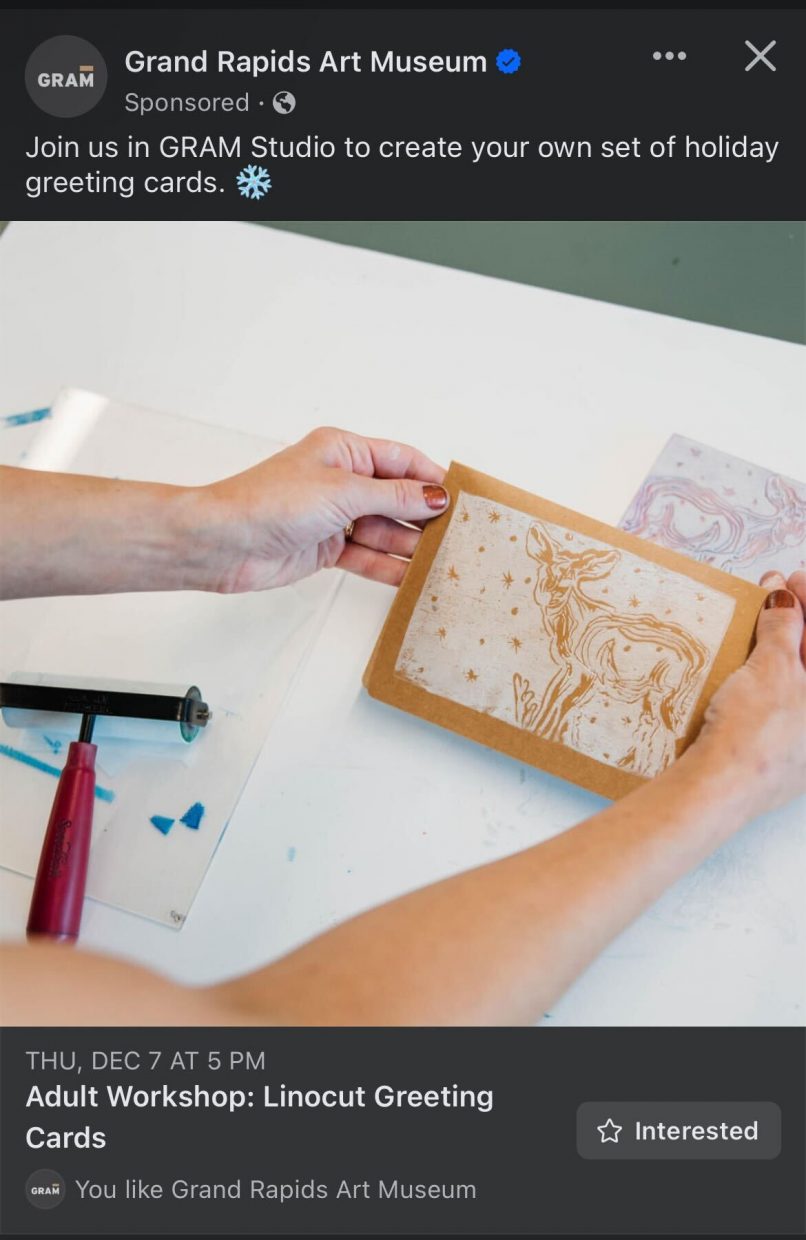
While scrolling through your Facebooks feed, you may have come across a post from an account you are not currently following.  This post, under where their name is will have a little bit of text that reads, “Sponsored”.

This means that the advertiser paid to make sure this post shows up in front of you.  The more money applied to the boosted/sponsored post.  The more people that will be able to see it!

It is important to note that a boosted post is the same as a sponsored post.  As they can be referred to as both around the online world. 

A boosted post like this is great to increase general brand awareness.  If you are boosting a post that is interesting, eye-catching, and new to your audience, it may help your company get in front of new eyes! This is a good opportunity to show just a bit of who you are and what you offer so you can get more eyes on your business. 

A sponsored post is also good for engagement with a specific post.  If your post comes across their feed, they may be more inclined to interact with it, giving you more engagement and interaction that could lead to conversions.  

What is a Meta Ad?

Made with the Meta Ad manager, running an ad through Meta allows for you to have a series of images and copy that can be posted in various ways across all the platforms that Meta has ownership over.  For the most part the focus is on Facebook and Instagram. 


While you can have a sponsored or boosted post on Facebook and Instagram, running an ad or an ad campaign through Meta can allow you to have visibility on both platforms simultaneously.  

An ad campaign is a series of ad posts that all focus on one thing.  The posts of an ad campaign could all focus on a new product or upcoming event.  

Based around the goals of your business, a Meta ad or campaign allows for more specific targeting, as well as the ability to learn more about your audience over time. 

To read a deep dive into What Exactly Is A Meta Ad, check out our blog!

Advantages and Disadvantages of a Boosted Post

One disadvantage of a boosted post is less engagement when compared to an ad.  While you may get some post interaction, you may not get as many people following your post to your actual website. 

The advantage to a boosted post is that they are easy and quick to create.  It takes about as much time as creating a regular post usually takes. 

A boosted post is also great for reaching people that are connected to your current audience.  This means friends of friends, followers, and other connections your audience may have.   

Advantages and Disadvantages of Meta Ads

Unlike a boosted post, an ad or ad campaign takes much longer to create, especially depending on how long you want your ad to run.  Ads are also normally much more in depth and carefully structured.   

With a Meta ad, you will also be more likely to get better results.   

Ultimately, it depends on what your needs are and what your goals for your business may be that will help you choose whether a boosted post or a Meta ad is better for you! 

Unsure of where to start? Boosted post or ad, we can help
with both!

Contact our marketing team today to see what we can do for
you!

Ready to Run Ads with Facebook? Here’s Where to Start!

Need Help With Facebook Ads Get Expert Guidance

Are you looking to expand the reach of your company? Do you want to start showing your ads to potential customers, but have no idea where to start? Facebook, now Meta, is a great place to begin your advertising journey.  Read more about Facebook’s Name Change To Meta

Not only can Facebook help you get in front of such a large group of people, but it can get you in front of those people who need your exact product or service.  Showing your ads to the right people will not only streamline your audience, but it will also help you get the most bang for your advertising buck. 

So, What's the First Step?

The first step in starting to advertise on Facebook is to Set Up A Meta Ads Account.

Once you have an account created, you will need to install a Pixel into your website, so Facebook can accurately monitor stats and help point people to your site via ads! 

What is a Pixel and Why Do You Need It

A Meta Pixel is a piece of code that you can install on your website, very similar to the process of Google Analytics.  This piece of code will then allow you to monitor what people do on your site, as well as retarget people who have already visited a specific page on your site with more ads. 

A Pixel is very important, as it essentially helps Meta create a specific audience for you to continue to have effective and successful ad campaigns. 

How to Install A Pixel

There are two different ways to install a Pixel on your website.  First, you can install it through a partnering platform such as WordPress, Square Space, Shopify, or WooCommerce.  Meta has a full tutorial to help you with this process. 

Second, if you do not operate your site with any of the above platforms, then you must install it manually.  This process involves copying the code and inserting it in a specific part of your website’s code, usually the header code.  Meta also has a tutorial for this process. 

Have more questions or need help Troubleshooting Your Meta Pixel

How Do Ads Work? Explaining the Ad Auction

Essentially, what Meta does is allow your ad to compete to be shown every time there is an instance that an ad can be shown across their websites/platforms.  They are trying to get your ad in front of the eyes of the people most likely to be your true audience, those who will interact with your ad. 

Meta states that there are five things that they take into consideration when it comes to picking when and where your ad will be shown.  These five things are Objective, Targeting, Budget, Duration, and Creativity.

Objective

There are 6 objectives you can choose from when it comes to creating your ad.  Awareness, Traffic, Engagement, Leads, App Promotion, and Sales.  Depending on which one you choose, you are effectively telling Meta what the goal of your ad campaign is.  You will select an objective based on what you are trying to generate for your business. 

·         Awareness: This is the goal of wanting to get your ad viewed by as many people in your location as possible.

·         Traffic: This objective aims to get people to visit your website. 

·         Engagement: Like Traffic, this goal wants an increase in interactions from people to your posts or website. 

·         Leads: Leads are the objective that has the goal of getting real contact information of real people for you to utilize. 

·         App Promotion: This goal is great if you have an app and can be used to generate downloads. 

·        Sales: The objective is to encourage sales within your page.  

Targeting

This is the portion of your ad that is focused on reaching your target audience.  If you are a landscaping business, then you would want to target people with homes, or businesses, that have yards or landscaping plots that need taking care of, therefore you may want to target married couples of homeowning age, or older ages in certain neighborhoods that you know are a lot of business, or even certain areas that have a lot of residential homes with yards, etc.  

Budget

Your budget has a lot to do with how your ad functions on the ad auction.  How much money you set for each ad will directly correlate to how many people will see your ad. 

You can set either a daily budget or a lifetime budget. 

A daily budget is exactly what it sounds like, a budget that is set for either your campaign or your ad that runs over a day.  It will be how much you want to spend on a day-to-day basis for your advertising. 

A lifetime budget is how much you will spend over the whole duration of your ad or campaign.  This is great for those who don’t want to go over a certain amount of money overall.  

Duration

This is the date range for your ad that you get to set.  The longer your ad runs, the better it will do, as more people will see it.  Scheduling your ad is very important, and factors like the time and date should be taken into effect.  Will you show your ad more on days people are less likely to be working? Will you not run ads on holidays? Knowing these things is important for the overall ad process.  

Creativity

Is your ad original and eye-catching? Ads with similar theme colors to their landing pages, as well as remaining visually interesting and clean will always do well compared to cluttered, spammy ads.  

What Makes a Quality Ad?

It is a great idea to have your ad always remain relevant to the landing page you will be sending people to.  Doing the opposite can give your ads a spam-like feel.  Keeping a uniform color scheme and neat text and fonts also encourages clicks. 

Ad quality is important because the more your ads get recognized as quality, rule following, and safe ads, the more Meta will learn that they are the best kind of ads to be promoted.  Otherwise, they will get suppressed.  

What Could Get Your Ad Rejected?

Any form of profanity or promotion of harmful and obscene content will most definitely be a recipe for disaster.  Other things, like misinformation, reactionary content, hate speech, and promoting illegal things are bound to get your ads suppressed or rejected.  Use common sense and keep your ads straight to the point and you’ll be just fine! 

Meta ads are a huge component of the world of online advertising, and hopefully this blog helped explain it a bit more!

If you need more information, HubSpot has a great Facebook Ads Checklist!

Looking to get your Facebook Ads up and running? Contact the Spectrum Net Designs Marketing team for all your marketing and advertising needs!

What Content Marketing Looks Like in 2023

Content Marketing Trends to Keep an Eye On

It is no small secret that content marketing can be very advantageous to businesses.  From blogs to videos to social media, producing content can help you gain, and keep a loyal audience.  In 2023, it’s not enough to just have a great product or service, promotion and connection are at the forefront of a solid content marketing strategy.

Hands typing at a computer.

A Few Things That Will Never Go Out of Style

  • Value-adding, quality content.
  • A user-first experience that is human focused.
  • An authentic, empathetic, and connection focused approach.

Audiences now are less likely to want to be sold to and would rather spend their dollars on a brand and company that they feel a strong connection with.  Gone are the days of pitches and slogans. Focusing on connection will help in the long run. 

Here’s what we think will be big for the rest of the year! 

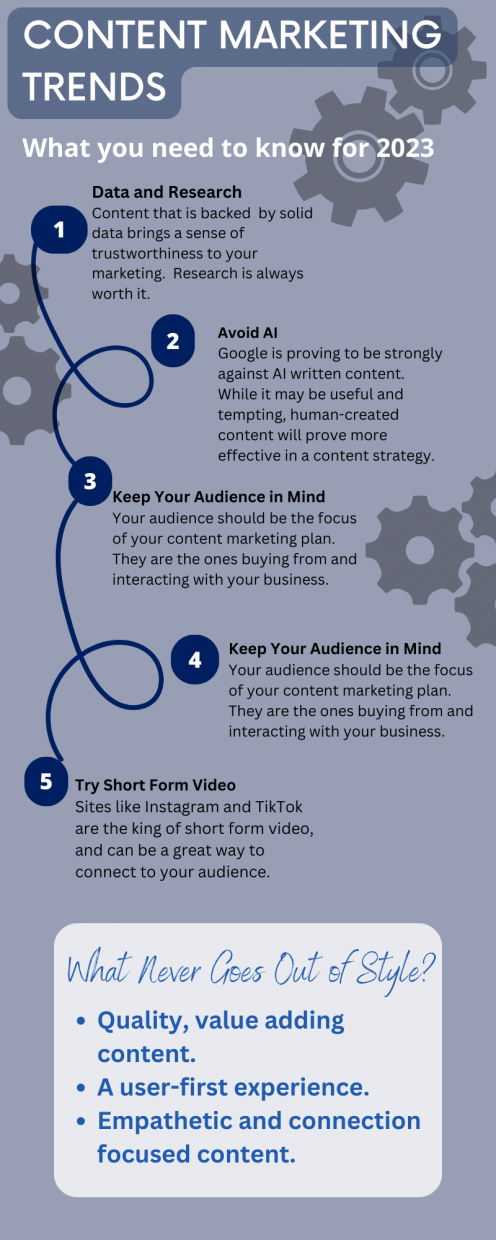
1. Data and Research

People will be more inclined to trust your content if it is backed by research and even uses data, depending on the topic.  This not only makes it trustworthy, but ultra shareable, giving you more eyes on your business as well as highlighting your company as a thought leader in your industry. 


2. Avoid AI

With AI, it is difficult to get accurate content.  As we know, Google promotes human focused content that isn’t spammy or manipulating search results and isn’t completely against AI content.  However, as the world of AI is still new and possibly under researched, it is best to have a human create the content to keep the focus on the reader and the audience.  

3. Keep Audience Conversions in MInd

While we as a collective may be beyond the point of using slogans and pitches, a call to action or an incentive to interact or complete a purchase is necessary.  By keeping the approach connection-focused, you can draw more people in organically.  

A woman in front of a filming set up.

4. Give Short Form Videos a Try

The beautiful thing about this form of video is that it is attention grabbing and highly shareable.  Social media platforms such as Instagram and Facebook’s Reels, TikTok, and YouTube Shorts are all great places to try out and post these short form videos for an increase in engagement. 

To learn how to optimize your video content for search engines, check out our blog on video SEO here! If you’re interested in learning even more, read our eBook here

5. Utilize SEO

Search engines have taken the time to figure out what humans enjoy reading and watching, so it’s important to create an SEO plan based on what search engines want.  Research different keywords to use in and as the title of your content to help it rank as high as possible on Google.  

An inforgraphic detailing the content marketing trends of 2023

Everything You Need to Know About Facebook’s Name Change to Meta

Why Did Facebook Change To Meta?

In October 2021, Facebook made the decision to change its name to Meta.  This decision came into effect on June 9, 2022.  This was brought about due to several reasons, but the biggest reason is that Facebook and Mark Zuckerberg had decided that the company was in need of a rebranding. 

This comes after much debated issues, such as privacy concerns and misinformation battles, and the widely known fact that Facebook acquired Instagram in 2012 and WhatsApp in 2014.   

You may have seen the news of a name change and are now wondering, “What does this mean for me?”

If you use Facebook for your business, or even personally, you may be worried that this means something drastic for you.  Have no fear, we break down everything you need to know about this new name change below!

A collection of buttons with facebook logos.

Why Did Facebook Become Meta?

If you’ve been following the news, Facebook has become so much more than just a social media website now.  They have expanded so much (even beyond Instagram and WhatsApp) in the last few years alone, and they needed a name change to reflect that.  Meta and Mark Zuckerberg are now turning their focus to the “Metaverse”, a virtual world where people can interact, work, and connect.  This is all done through a mix of virtual reality (VR) and augmented reality (AR).

What is Virtual Reality?

Virtual reality is the immersive world created to appear 3D and interactive to the user.  You can usually be a part of a virtual reality world by wearing a headset to replace your natural vision and the use of hand controls.  Most virtual reality games and spaces require standing to have a fully immersive experience.  

What is Augmented Reality?

The most popular example of augmented reality is the game Pokémon Go, which first made its appearance in 2016.  This game utilizes your smartphone’s camera to overlay a digital display of a character or setting.  For the Pokémon Go game, characters are projected onto your real-world surroundings, and a map of your area is available with places you can “visit” with that map.  

What is the Metaverse?

With virtual reality being bigger than ever, Facebook has set its sights on that realm.  After acquiring the virtual reality headset gaming system Oculus in 2014, Zuckerberg and Facebook have decided their next projects are going to be focused on creating a world that is entirely virtual. 

The Metaverse will be a place you can enter through a headset and can interact with people and businesses in real time, while never leaving your home.  With this new technology, Facebook aims to revolutionize the personal and professional spaces.  

So, What Does This Mean for Facebook Users?

Both those who use Facebook for personal and business needs can expect not much to change.  Like Google rebranding to “Alphabet” in 2015, the only real change is that the parent company of Facebook will change.  Your pages will stay intact!   

What Does This Mean for Facebook Ads?

Facebook ads will remain pretty much the same, with the umbrella brand “Meta Ads” now. 

Are you interested in having an ad campaign of your own?  Do you want more eyes on your business?  Contact the Spectrum Net Designs Marketing team today to see how we can help you!  Our ads bring traffic to your sites and business because we know Facebook (and Meta). 

As we can see, this change is just a small rebranding, with big dreams.  Facebook is looking to expand, and as they are one of the biggest companies in the tech sphere right now, it is important to keep an eye on its next moves.  While the Metaverse is still in production, its invention will most likely change the course of reality as we know it.  Keep an eye on our blog for more updates!

Why Is No One Reading My Blog? 10 Tips to Get Your Blog Views

Why is No One Reading my Blog? 10 Tips on How to Get People to View your Blog!

As we have heard many times over the past few years, “Content is King”, meaning that content is key in growing your audience and helps you play the long game in marketing. A good way to create content for your website is to create a blog.  A blog is a fantastic addition to your site, as it lets you continually add content, with each blog bringing the chance of new eyes on your work or business. 

However, a blog without views doesn’t do very much for a website. So, you’ve got your blog up and running, but there are no views! Are you wondering why that is? Read on to hear our top ten tips on how to get people to view your blog!

A woman seated at a desk working on a laptop with a mug of coffee beside it.

Tip #1: Have a Consistent Focus

Narrowing down the focus of your blog helps you target an audience directly.  The goal of your blog should be to establish yourself as a thought leader in your focus area.  While it may seem appealing to write about a variety of topics, readers may end up confused about your blog when you are writing about flowers one week and birds the next.  Targeting a specific topic, and in turn a specific audience, makes it easier for people to know that you’re the one to come to about your chosen topic. 

Not only does this help readers, but keeping your blog about one topic helps you rank on Google as well. Google combs through your site, following links and checking keywords that you may be using to learn what your blog is about.  Sticking to one topic helps Google show your site on the results page when people are searching for the topic you are writing about.  

Tip #2: Research SEO Before You Write

Research some relevant SEO keywords to include in your blog before you start writing, in order to build your content around those keywords.  You could even go a step further and use SEO to create a content strategy based on SEO and topical relevancy. To read more about this, check out our blog here

Tip #3: Use Hierarchal Formatting Correctly

Using hierarchical formatting, like H2s and H3s (in correct descending order). Not only helps your readers follow and possibly skim your content, but it also helps Google “read” your content, allowing your blogs to be indexed properly by Google.  

Tip #4: Utilize Backlinks and Internal Links

Backlinks:

Backlinks are links to your content from other sources.  Having backlinks increases your authority and gets more eyes on your content.  You can get these by reaching out to other bloggers and websites and getting them to link to your content!

Internal Links:

Linking to your own content within your own posts allows your readers to discover more of your content, and it also helps Google to crawl your content and learn about what your content is focusing on in order to show your site on Google.  

Tip #5: Add a Call to Action

Adding a call-to-action, such as a call to subscribe via email or check out another section of your site, can be a very effective way to encourage your readers to continue their descent into your content without sounding too salesy.  This is most likely done at the end of your blog post.  

Tip #6: Craft Good Headlines

A good, attention-grabbing headline is sure to get your audience to click on your blogs.  Keep them simple, but explanatory, and you’ll be set.  To learn more about how to craft a solid headline, check out this WordPress article.

Tip #7: Make Your Content User Focused

It can be said that readers are more likely to continue reading content that is more focused on them, and less about the author.  While it may be tempting to talk about yourself, it may be best to make sure your content is at the most useful as it can be to your readers, to keep them on your blog, and to keep them coming back.  If you keep it genuine, and not just about sales or yourself, it will draw readers in.  

Tip #8: Post Consistently

Being consistent keeps you at the forefront of your readers’ minds, as it is easy to forget about a blogger if they are inactive for some time.  Post regular content, and batch write your blogs to schedule ahead of time when you are feeling super inspired to avoid burnout.  

Tip #9 Promote on Social Media

Do you post your blogs to your social media? Do you have buttons for each social media site on your blog that make your content more sharable? Do you have an easily pinable image that readers can use to share this content on Pinterest?  Having all of these things in place helps you and your readers utilize social media to spread your content. 

Posting a blog is half the battle, the other half is promoting it on social media.  Doing things like making a cool graphic and posting links to your social media will greatly increase your chances of fresh eyes on your blog.  

Tip #10 Prioritize Helpful User Design

If your website is hard to navigate, readers may not want to stay on your site very long.  Make sure you have a good design and a good user interface to appeal to new and old readers.   

Another element to consider is that you will want to make sure your blog and site have a quick loading time; usually, about three seconds or less is ideal. If your site takes 9 seconds to load, it may deter your readers from staying on your blog.

Build a Content Strategy with SEO: How to Plan for Content That will Bring Conversions

Build a Content Strategy with SEO: How to Plan for Content That Will Bring Conversions

If Google’s updates this year have told us anything, it’s that content is key to a good SEO strategy, and SEO is needed for good content.  But not just any content will pass the test of Google rankings.  Google is telling us that generating quality, helpful content can help you gain the organic traffic you need and can also help you rank on Google. Ranking on Google opens the doors for many new eyes to be seeing your site, which will hopefully lead them to interacting with your site, or even completing a sale.   

Search Engine Journal writes that the market for content marketing is going to grow over 500 billion dollars between now and 2027.  This huge amount of growth prediction shows that business owners are putting their eggs into the content marketing basket.  Now more than ever is the time for content strategy.  

Some worry that AI is going to quickly replace content marketers, and the need for producing content, but I can assure you that is not the case.   AI is still in development and is prone to mistakes.  Human first content will always be the best avenue.  Google has said themselves that they are already in the process of learning how to spot and keep AI generated content from ranking on Google.  As internet users prefer spam free, useful content, so does Google.   

A hand is connecting ideas together on a board.

What Content is Google Looking For?

Google has shown us time and time again that they want us to produce human-first content.  They don’t want us producing spammy, repetitive content, rather, they want us to put our time and energy into producing content that will be useful to users of the internet. 

When someone is browsing the internet, they will most likely be inclined to stay on the pages that serve them and will be quick to leave the pages with useless and unreadable content.  Google improves with each update and gets better and better at weeding out spammy content, making it best to keep on the side of content production that best meets the user’s needs.   

Why Google?

Whether liked or not, Google is the most used search engine and they have become synonymous with the action of researching, or looking something up.  The name itself has become a verb, as the saying goes, we all know how to “Google it”.    

Google has been the top search engine and search authority for years now, and its algorithm changes are what the experts look to for guidance when it comes to updating SEO strategy.  It is important to pay attention to Google, as they predict and control the trends of SEO, content marketing, and beyond.  

How to Write High Quality Content

·         Proper Keyword Density: We know by now that Google penalizes keywords stuffing, yet the alternative of having too little keyword representation can keep you from ranking as well.  Try to find the happy medium of putting the keyword throughout your content where it could naturally fall. 

·         Natural Language: Google may not be physically reading your content, but humans will be.  If it sounds clunky, boring, or even too pretentious, then you run the risk of losing those valuable eyes on your content.  Conversational language is key to a happy audience. 

·         Minimal Repetition: Content should be to the point.  Don’t try to repeat yourself just to make your content longer.  Use as many words as you need to in order to completely explain your topic and stay away from fluff.  

Another great way to produce thoughtful and quality content is to follow the E-E-A-T method.  

What Is E-E-A-T?

“E-E-A-T” is a phrase coined by Google that means Experience, Expertise, Authoritativeness, and Trustworthiness. 

·         Experience: Do you have an experience with your topic? Be sure to talk about it!

·         Expertise: Are you an expert on the topic? Can you interview an expert in the field to elevate the expertise of your content?  Be sure to also be linking to quality sources, as gives weight to your words. 

·         Authoritativeness: Present your content with authority.  Your content from beginning to end should get right to the point and stick to that point throughout. 


·         Trustworthiness: Are your sources quality? Are you being honest? People can tell when content isn’t trustworthy or are being dishonest with them.  

What is Topical Relevancy?

Topical Relevancy is the practice of building out content based on the topics of the service or blank that your business provides.  The more quality content you build out, the more your site will be seen as an authority in that field of your choosing. 

The types of links you have both linking out of your site, within your site, as well as too your site can greatly advance your topical relevancy and authority. 

The process of achieving topical relevancy is essentially the act of building content, and then making sure that content has inbound and outbound links that are relevant to the content. 

For example, if you are a construction company, you could produce content about building homes.  In order to further build out this content, you can then begin writing content about the more specific aspect of building a home, such as wiring, plumbing, bath trends ETC, and then begin linking to your own content within your content. 

Google determines authority and relevancy based on the number of links that connects your content.  Building out your content and interlinking it, as well as adding links out to other trustworthy sources, signals to Google that you are also an authority.  

How to Find Topics to Write About

Using a good keyword research tool is the best way to find topics regarding your content that you can write about. There are many free tools out there for you to utilize.  Sites like Google Trends and Google Keywords are very good for initial research.  They allow you to find questions that people are asking based on the keywords and topics you are researching. 

You can also utilize autocomplete, to see what other people are asking Google, and base your topics off of that. 

Once you’ve found a few good topics, then you can start finding keywords.  

How to Find Keywords

Look at your topics, can you use a keyword research tool to find keywords that have a high volume, that may be synonymous with your topic?  Using a keyword research tool is a great way to learn how strong the keywords you want to work out will be. 

Look at your competitor’s keywords.  Can you draw inspiration from them? Are there some they are using that could also work for you?

If you’re looking for a dedicated, hard working team to find quality keywords, narrow down some effective topics, or even create your content for your site with authority and expertise, contact our marketing team to see how we can help you today!

As Google is constantly updating and evolving their algorithm, so must we.  Content should be up to their standards.  Search engines also want us to produce high quality content, with Google specifically wanting us to focus on the person who is visiting our site, our audience, and our users.  Keeping all of this in mind, as well as your SEO keywords, will help you get well on your way as you formulate a content strategy.  Happy Content Making! 

Captivate and Educate: How to Create Interesting Niche Content for Anyone

How to Create Niche Content for Anyone

Are you trying to draw in the right people for your business? Are you looking to create actionable, interesting content? If so, then finding your niche may be what you need.  Finding your niche may lead you to a loyal audience that keeps coming back for more. 

So how do you cater to this audience? One way to find and keep people is by creating content that they will want to read.  Creating content for a niche can be a challenge, so let’s make it easier for you by giving you the top tips for writing quality niche content.  Read on to learn more!

What Is Niche Content?

A niche is a smaller piece of the larger whole.  Whether that larger whole is a content topic or the type of target audience you have, it is important to establish your niche.  This will give you topics and ideas for content that are easier to target.  For example, it is easier to target the niche “roofing services in the greater Boston area”, than it is to target “construction” because you have now chosen an exact audience that has a particular need.  Finding your niche helps you be more specific, thus attracting a more loyal, organic audience and traffic. 

When you find your niche, you may want to begin writing and creating content to fit within it.  Creating subject matter that targets your niche can help you become known to the audience that fits within that niche.  

How to Find Your Audience?

whiteboard with arrows and the word audience written on it. The arrows are pointing to the word Audience.

Besides basing your content and business ventures on what is most popular for you, it is good to know the demographics of your audience. This can help you narrow down your niche as well.  Contact us to learn more about your audience and to see how the Marketing Department can help you target your audience and niche better!

How Can a Niche Be Beneficial?

A niche can be very beneficial in many ways.

·         Less Competition: Fewer companies and people are fighting for the attention of your audience if you are targeting a niche. 

·         Brand Advantage: You can be the first brand to establish itself as a leading expert in that niche, allowing yourself to become as synonymous to your niche as John Deere is to tractors. 

·         Loyalty: A smaller audience means more opportunities to connect on a personal level. 

Niche Content and SEO

If your company wants to pull in and attract more of a specific kind of audience, then you should be using SEO practices when creating your content.  SEO stands for “search engine optimization” and is the practice of placing popular keywords within your content, to gain the attention of search engines.  This causes you to rank higher on search engine results pages. Ranking higher on results pages means people are more likely to find and click on your content. 

SEO allows you to use keywords that are specific to your niche.  This lets you target your niche subjects better and put yourself in the view of your specific audience. Contact us today to see how our SEO services can work for you!

How Do You Find Your Niche?

Now that you are aware of the fact that targeting a niche is a good strategy for your business or website, you may be wondering how exactly you can find your niche.  When looking for your niche, it is important to keep these themes in mind:

·         What topics do you want to focus on? What are you passionate about? Knowing what you want to create when it comes to your business ahead of time can help you have ideas about what niche you want to target.  For example, if you have a passion for writing about farming, you can create content to target a specific niche of a specific animal or crop, like chickens or corn, as that would be easier to gain traffic. 

·         Research the markets of your interests or business: Knowing your market can help you learn where there is a lack of representation.  If you want to target the subject matter of “lawn care” but see there is no one advertising for or creating content for the topic of “best flowers for pollinators” then you have found a niche to target. 

·         If you already have a business:  Research your audience and what seems to be the most popular item you sell or service to provide.  That can give you an idea of what niche to target.

·         Be specific: Broad topics have more competitive populations when it comes to representation online and otherwise. 

·         Research niche competition: This allows you to gather ideas based on what your competition is doing.  

A person in a yellow seater site ad a wooden desk, typing on a computer.

How to Make Your Content for All, While Still Targeting Your Niche

·         Keep an eye on what’s trending: Following popular trends that fit well with your content to gain the attention of a wider audience. 

·         Be personable: This helps you reach outside your audience, build rapport with them, and educate them on something they may not know but is still easy to learn due to your overall tone and presentation of the topics.   Having a personable tone also shows ease of knowledge and can position you as a popular authority in the niche. 

·         Be an expert: Asking questions, creating lists, and writing “how to” articles are very popular blog ideas.  People who are looking for these types of blogs will see you as a thought leader in your niche, hopefully bringing steady and new traffic. Use visuals and concrete evidence to back up what you are saying, and you’ll be well on your way to being an expert. 

·         Know how to answer common questions in your niche: This will bring new people looking to get common questions answered to you.

Beware of Going to Niche

If you find yourself with little to no competition or audience, you may have gone too niche. If you are targeting the very specific niche of “computers for husbands with eye problems” rather than “computers for people with eye problems” you may run into these issues. Remember, absolutely no competition
means no traffic. 

No matter the size of your business, you can benefit from targeting your niche with good, quality content.  Contact Spectrum Net Designs today to learn more about our content writing services and see how we can increase traffic to you! 

2023 Email Marketing Tips

email marketing tips

2023 Email Marketing Tips

2023 will be a big year for data privacy and more importantly to marketers as people will look to them to protect their personal information. 

In addition, the downfall of third-party cookies is making it harder to target customers through paid ads so marketers are looking for a channel that enables first-party data collection. And that is where the wonderful world of email marketing comes into play!

While many of you are probably already utilizing emails in your current marketing strategy, are you using them effectively to deliver personalized content to your target audience?

So, we’re going to dive into some of the best tips for email marketing success for data capture and engagement. Let’s go over them.

Personalization, Personalization, Personalization!

Email marketing tips number one! Here’s the simple fact regarding this, personalization works. Despite the success of this tip, customers feel that companies aren’t living up to their expectations when it comes to understanding their needs and personalization expectations.

Don’t be one of those companies! Incorporate personalization in your email campaigns to help drive both the open rate and engagement. This can be demonstrated through something as simple as including the recipient’s first name in the subject line or even contacting people on special occasions like their birthdays.

Another way to add personalization to your email marketing is to make your email from a person, not a business. You do this by including a person’s name in the “from” section. This will provide a name to your email when arriving in the recipient’s inbox. You can also include a photo for your profile picture rather than a logo.

Write a Catchy Subject Line

We’re sure you’ve heard this one before! The subject line is the first thing a person sees in their inbox so take the time to craft one that is relevant and attention-grabbing. This might be easier said than done so let’s go over some tips for writing a solid subject line.

  • Ger personal- as mentioned above, use the name of the recipient in the subject line or refer to something that will resonate with them.
  • Use humor- People are more willing to open an email that makes them smile or intrigues their curiosity. Don’t be scared to use humor here but make sure it’s something your audience can easily pick up on.
  • Include emojis- People are used to using emojis so include one that is relevant.
  • Use powerful language- stay away from boring or cliched language. Try to use works that excite or invite some type of action.
  • Hint at the content inside- your subject line should provide the recipient with what is inside so don’t just use a headline because it had a good open rate last time. Make it relevant.
  • Make people curious- people have major FOMO (fear of missing out) so use that to your advantage when crafting a subject line.

Connect With Us

Facebook
Twitter
YouTube
Pinterest
LinkedIn
Instagram

Categories

Recent Posts

Archives

Audit and Clean Your Email Lists

With the downfall of third-party cookies and Apple’s Mail Privacy Protection, it’s more important than ever to be mindful of capturing and using data to ensure the protection of customer information.

Email is a perfect example of a first-party data source- consensual information, and you should do your best to protect it. It’s important to look through your database and clean it up. Make sure you have permission to use every email address you have in your lists. If someone has unsubscribed, make sure to take them off your active lists.

If you keep a list of those unsubscribers or inactive, try reaching out to them to re-engage and offer to remove them if it’s no longer relevant. After all, quality over quantity here!

Use Omnichannel Marketing

Heading into 2023, utilizing omnichannel marketing is a growing strategy for companies of all sizes.

Omnichannel Marketing is when you use every marketing channel to its full potential and create a seamless customer experience from one channel to another.

Email marketing has an important role in omnichannel marketing. Email marketing has an advantage given it’s flexible, easy to customize, easy to test, and provides insight into customer preferences and behaviors.

When using a combination of email marketing with social media, paid social, or SEM, email can drive engagement and build customer loyalty.

Include Relevant Links

Once someone has clicked to open your email, you want it as easy as possible and very noticeable where you want them to go. You shouldn’t just send a prospect or customer just to your homepage. Make sure you create relevant and customized landing pages that are a continued read from the email content.

Check Out How to Create a Landing Page for Your Business for More Information on this Topic.

It’s a good idea to also include your social media handles so people can easily find your brand online. Only include the platforms that you’re active on and make sure the content is up-to-date, cohesive with the rest of your brand, and responsive. 

Consider Interactivity

You can also try adding interactivity to your email by inviting people to swipe, click, tap, or watch. This could be a countdown clock, a video, or even a GIF. This just helps keep people in your email and dwell on it.

Have a Good UI and UX

Here are your last email marketing tips for the day! In this day and age, it’s extremely important to create a seamless experience for a prospect or customer across all of your channels. This means you need to think about the user experience (UX) and your user interface (UI) when including links in your emails.

For example, if you are offering a 20% off coupon, the next page they should be directed to is a page that provides an overview or description of the coupon with a simple CTA to enable them to purchase.

The design and colors should be cohesive with no confusion when a person clicks through if they’re interacting with the same company. Consistency is key. You should also optimize for mobile to ensure that your site is mobile-friendly and easy to navigate through.

Use These Email Marketing Tips to Take Your Strategy to the Next Level!

Now that you have a better understanding of all the elements that make up an effective email marketing campaign. Try to send your first email to either prospects or customers! Don’t forget to check the data after sending out your campaign as a baseline for future campaigns. Keep an eye on the stats to see which subject line had a better open rate? What about the time of day. What time of day had the most clicks? All these stats are useful for upcoming campaigns! If you’re looking for some help with any of your marketing strategies check out what our marketing services to see if there’s anything we can help you with!

Passive vs Active Voice For Content Marketing

Active Voice for Content Marketing

Passive vs Active Voice For Content Marketing

Active voice for content marketing helps you connect and resonate with as many people as possible

By writing in active voice versus passive in your content writing your readers will stay engaged with your material and you develop an authority on the subject you are talking about. Writing in the active voice might seem a little tricky but once you understand it, it’s very easy.

What is Active Voice?

Active voice is when you write a sentence, and the subject of the sentence carries out the action of the verb. The sentence will look like Subject + Verb + Object. To help better understand let’s break down the different parts of a sentence.

Subject: The subject of the sentence is the doer. They are the ones performing the action, or verb.

Verb: The verb, also known as the predicate, is doing the action. It’s action that the subject is doing.

Indirect Object: The indirect object is someone or something that is being affected by the verb but is NOT the primary object. When trying to find the indirect object try asking yourself to whom, to what, for what, or for what the verb is affecting.

Active Voice for Content Marketing

Now that you understand the different parts of a sentence, we can take a better look at active voice. An example of a sentence in active voice is: Spectrum Net Designs (subject) produces (verb) quality marketing materials (direct object).

What is Passive Voice?

Passive voice is the opposite of active voice. Instead of the subject performing the verb, the verb acts on the subject. The makeup of the sentence is Object + Verb + Subject. For instance, using the same sentence from above and writing in passive voice it would look like this: Quality marketing materials (Object) were produced (Verb) by Spectrum Net Designs (Subject).

Why is Active Voice Important?

Coming from a content writing perspective there are several practical reasons why the active voice is important to implement.

Using Active Voice Creates an Authoritative Voice:

Company executives, business owners, and industry experts all want to sound credible and authoritative. The use of fewer words, being direct, and straight to the point gives top-level professionals a strong writing delivery. This is because an active voice sounds more direct. It allows you to give a straightforward delivery that provides the reader with helpful information.  

Active Voice is Easier to Read

Less is more when it comes to content writing. Using fewer words will allow you to get to the point quickly and fill your article with more meaningful content. Instead of complex sentences that force the reader to interpret the meaning, the active voice provides short, direct statements. For example, We wanted five bundles this summer is a lot easier to understand than, This summer, there were five bundles wanted by us.

The example demonstrates that if you fill your paragraph with passive sentences, you will eventually exhaust your readers.

Active Voice Uses Fewer Words

An active voice sentence, as mentioned before, will always use fewer words than a passive voice sentence. Passive voice sentences typically require additional words like “was”, “by”, “be”, to ensure the statement makes sense. For example, The trash was taken out by Jessica is written in passive voice and uses more words than the active version: Jessica took out the trash. Active voice gets to the point to help the reader understand what is being said right away.

Why is Active Voice Good for Content Marketing?

When you use active voice in content marketing, it will help your content be more engaging for your readers. Sometimes passive voice can feel like you are reading an educational essay. This might deter your audience from your work and find other content that is more readable. Whether you are creating direct marketing, like ads and copy, or indirect marketing content like blogs and articles, using active voice will help capture and hold your audience’s attention. It’s also helpful for your readers since it delivers information quickly and easily.

Active Voice for Content Marketing

When someone clicks on your content, they will probably have questions that need answering. It’s important to not bog them down with fluff or complex sentences, instead provide them with the important information right away. This also encourages them to return to your content more often when they have additional questions.

Get Active in Your Writing Style!

When it comes to Passive vs Active voice for content marketing, using the active voice consistently is one of the toughest elements in content writing. However, once you learn how to master it, you will find that it drastically improves your writing and enhances your content’s readability.

Need Help With Your Content Marketing?

Contact the Spectrum Net Designs Team Today!

Connect With Us

Facebook
Twitter
YouTube
Pinterest
LinkedIn
Instagram

Categories

Recent Posts

Archives

How to Optimize for Voice Search

voice search optimization

How to Optimize for Voice Search

The allure of voice search is undeniable- it’s faster, hands-free, and lets you multitask.

Voice search had made its appearance in the mainstream in 2011 with the launch of Apple’s Siri on the iPhone 4. In 2015, the Amazon Echo became one of the first established smart home devices. From there on, several competitors entered the voice search market.

By now, you have been exposed to at least one of these products and understand that the growth of the audio market has created many opportunities for your brand to connect with users, especially in e-commerce.

What is Voice Search?

Voice search is the action of using speech to ask questions or give commands to compatible devices like smartphones or smart speakers. The searcher speaks into the device, and the device fulfills the command or answers the question.

How Does Voice Search Work ​

Without getting too technical, digital voice assistants work by:

  • Processing and transcribing human speech into text.
  • Analyzing the given speech to detect questions or commands.
  • Connecting to external data sources, such as search engines, to find the relevant and sought-after information.
  • Translating that information into a digestible format to fulfill the given question or command.

As voice search evolves from voice recognition to voice understanding, Google gets closer and closer to its aim to transform voice search into an ultimate mobile assistant that helps you with your daily life so that you can focus on the things that matter.

If you haven’t started thinking about incorporating voice search into your SEO strategy, now is the time. Let’s look at some strategies that will take you into 2022 and beyond.

Strategies for Voice Search Optimization Success

At the voice search optimization core, it is similar to the SEO of today, but with a refined focus.

#1 Understand Your Customer and Their Preferred Device Type

Since the voice search algorithms utilize data, location, and several other data points to understand search context, marketers must dig deeper into understanding their consumer and their behavior.

#2 Focus on Conversational Keywords

We don’t believe that short-tail keywords will ever disappear entirely, but they do become less relevant when we consider the natural phrases used in voice searches. When optimizing for voice search, it’s more important than ever to focus attention on conversational long-tail keywords. Come up with a list of questions that your product or service answers and incorporate those questions into your long-tail research to capture the voice search audience.

#3 Create Persona-Based Content

Brevity, context, and relevance are critical to master when optimizing for voice search. Something different from your usual SEO practices is that now you need to also pay special attention to:

  • Creating detailed answers to common questions.
  • Answering simple questions concisely and clearly

Aim to create rich, compelling content that answers the questions that your users are searching for. A proven strategy that many websites have begun to adopt is to:

  • Create content or a webpage with a headline that asks a common question from your audience.
  • Immediately after the H1, provide a very concise definition of the question.
  • Use the rest of your page, after answering the question, to provide further elaborative detail on the topic.

The great thing about this strategy is that the rich, elaborative webpage has everything that Google is looking for to rank your page. On the other end of this strategy, the short-and-sweet information at the top will be optimized for voice search and has the potential to become a featured snippet.

#4 Build Pages that Answer FAQ

Typically, voice searches begin with “Who,” “What,” “Where,” “When,” “Why,” and “How.” Voice searchers are looking for answers that fulfill an immediate need. Think about answering these queries and making an FAQ page, and begin each question with those adverbs. When doing something like this, try your best to answer them in a conversational tone to help appeal to the voice search inquiries.

From a performance perspective, make sure that your website is technically sound and includes some schema. Ensure your navigation and informational structure are easy to find, and your page speed is fast.

#5 Think Local & Think Mobile

We already know this; we are moving to a mobile-first world where devices and people are mobile. Because of this, it is important to remember that mobile and local go hand in hand, especially for voice search. Mobile devices allow their users to perform on-the-go local queries. In turn, voice search enables users to ask hyper-local questions.

Make sure things like directions to your location and XML sitemaps are readable to visitors and search engines on your website. You can also create different experiences for desktop and mobile users- i.e., optimize for “near me” type searches on mobile. Lastly, focus on your mobile strategy and make it sound as well as keep page speed and load times top of mind.

Wrapping Up!

Not everyone is ready to move forward with voice search optimization, as many who grew up in an age where technology wasn’t talking back to them still have a stigma attached to talking to phones. But the younger generations do not have the same hesitation, and most feel confident using voice search. Voice search is clearly on the rise, and marketers must start to become familiar with voice search optimization and best practices.

If You Are Looking for Assistance with Your SEO Strategy- Contact Spectrum Net Designs!

We support many clients, in various industries, and their SEO efforts. Let us help your 2022 marketing strategy be the strongest one yet!

Connect With Us

Facebook
Twitter
YouTube
Pinterest
LinkedIn
Instagram

Categories

Recent Posts

Archives

Are You Thinking About Your 2022 Marketing Strategy? You Should Be!

2022 Marketing Strategy

Are You Thinking About Your 2022 Marketing Strategy? You Should Be!

In the B2C world, both in-person and online shopping are seeing increases in their respective numbers. The challenge marketers are facing is to manage to think on their feet as trends begin, change, and quickly fade away. Fortunately, with our experience of observations from 2020 and 2021, we can create a solid 2022 marketing strategy that will take everything into account. Trial and error through 2020 and the first part of 2021 has given an advantage to marketers and a good grasp on what to keep, what to change out, and what tactics to start implementing in a new strategy.

Social Media Strategy for 2022

One area that continues to be dependable for a solid ROI is social media. Some insight from the first quarter of 2021 provides a good indication that social media will be in your “keep” and “change” column for your 2022 marketing strategy. What is interesting enough is that the biggest boom in activity wasn’t where most expected it to be. Of course, social media is in the keep column, but you also might want to look into tweaking a couple of things regarding your social media marketing outreach.

For instance, Pinterest is now attracting up to 5 billion searches a month. This isn’t just searches for décor inspiration, either. People were searching for actual products on Pinterest at a rate of 20x higher than the previous year. This is an increase of 150% from their average 2 billion searches a month in 2016. We suggest searching Pinterest with queries that are related to your specific industry and see what comes up. Are you competitors there? What type of content do you see? This is a great first step to see if Pinterest is the right avenue for you.

2022 marketing strategy

Facebook is still the most visited social media site, but TikTok has become a major platform for influencer marketers. The popularity of this platform happened so fast that in the beginning of 2020, TikTok influencer marketing wasn’t even an option and often fell under the “other” category. Over half of B2B marketers in the U.S. are now using Instagram, which is up from 30% in 2020. The platform actually did see its biggest decline in influencer marketers, down from 80% last year to 68% this year.

Experiential Marketing Strategy for 2022

We have come to the conclusion that virtual events are probably here to stay, for at least the foreseeable future. Brands have invested time and money into the increased technology that is necessary to help bring consumers together for various events on digital platforms. And the great news is that it actually worked! The majority of companies have noticed the same or greater attendance for virtual events than they’d previously expected for live events.

Since companies have been investing so much in technology that is necessary for virtual events, many organizations are likely to create hybrid events, with parts of the agenda that are accessible online. Incorporating a hybrid approach could involve the audience attending virtually or the speaker, or a mix of the two.

If you continue to host more virtual events, there will be a need for an on-demand strategy. Whether it’s a recording of your event that already occurred or a curated curriculum of courses, speeches, or other events made available to your audience. By creating a 2022 marketing strategy for live and hybrid events, you’re allowing the option for remote viewing to those who may not be comfortable with in-person activities or simply can’t make the trip to the event. Some statistics show that at least 20% of attendance at events comes from the on-demand viewing option. You don’t want to miss out on the opportunity to cast your net to your full audience.

Seamless Multi-Channel Retail Experiences

As more and more companies adopt a permanent work-from-home policy and consumers revel in the convenience of in-home streaming, finding new creative ways to reach buyers is more important than ever. Buyers love and take advantage of a multi-channel experience, but 90% of them say that incorporating a seamless experience is where they are most likely to spend their money. Your in-store, online, in-app, and out-of-home advertising should all cohesively work together to identify your buyer, understand where they are in their buyer’s journey, and help persuade them to complete a purchase without skipping a beat between your various channels.

When many hear the words multi-channel, they think of a website, social media, and an app all working together seamlessly. Of course, that is very important to a healthy multi-channel strategy, but that is not all you should be focusing on anymore. Also consider the entertainment streaming services. This will provide another avenue for you to potentially reach new customers. Traditional ads might become a thing of the past, but Hulu has introduced interactive ads that will provide an even richer experience for prospects who have already expressed interest in what you sell.

Another option is to consider making the most out of your out-of-home advertising strategy. You might think that billboards and bus signs are an expired tactic- a relic of the past that can’t possibly generate business. But there is a reason why out-of-home advertising is no longer called “traditional”. With the increasing availability through consumers’ cell phones, tablets, and other wearable technology, marketers are now more than ever able to change how to utilize out-of-home messaging that can reach their buyers. Nowadays, digital billboards can sync with a website that was viewed previously, there is nothing more omni-channel than that!

While it may seem impossible to completely predict the future and guarantee the results of these suggestions, you can plan for uncertainty by building out agile marketing plans and a comprehensive budget. If we have learned anything over the last 2 years, it’s that agile marketers are finding ample growth by testing new avenues and building a flexible marketing plan. By preparing to grow your brand’s reach through smart approaches to digital – there are some risks – but no doubt that marketers will be better prepared for whatever 2022 may bring! 

If You Are Looking for Any Help With Your Current or Future Marketing Strategies- Please Feel Free to Contact The Spectrum Net Designs Team for A Free Consultation! 

Connect With Us

Facebook
Twitter
YouTube
Pinterest
LinkedIn
Instagram

Categories

Recent Posts

Archives

Local vs National Marketing Strategy- Do You Understand The Difference?

local vs national marketing

Local vs National Marketing Strategy- Understand the Difference!

When deciding on utilizing a local vs national marketing strategy, it will be influenced by two key factors: the size of your company and your target market. If your target market consists of the local population, the strategy you will employ is different from that of a national corporation. What are these differences? Let’s explore the differences between a local vs national marketing strategy. ­­

Social Media Marketing

One of the first differences is the use of social media marketing for both local and national marketing strategies. Today, social media platforms like Facebook and Instagram have become valuable marketing tools. Depending on the audience you are trying to reach, these services should be used differently.

Local Social Media Strategy

If your audience is in the local population, you are capable to use social media more interactively. This is because the responses are generally limited. Strive to make local references in your posts, as this will catch the attention of the local consumers. If there are newsworthy events happening in your area, also try to reference these in your posts in increase engagement. There are about 40% of local businesses that are utilizing social media to help increase traffic and conversions.

National Social Media Strategy

National campaigns will use social media differently. Instead of referring to those local events, they will create generic posts and only refer to relevant national events. Unlike the smaller local companies, they can only respond to a small perfect of comments.

Whether You Are Looking for a National Campaign or Local Campaign We Can Help! To Learn More Check Out Our Full Service Marketing!

Marketing Method

The marketing methods that are used for local and national marketing strategies are typically different.

National Marketing Method Strategy

National marketing focuses on the promotion of a company. Large companies use this strategy to help get their brand out there, create brand awareness, and make it recognizable to their target audience. When customers see a brand regularly pop up, they are more inclined to trust it.

Local Marketing Method Strategy

On the other hand, local companies focus more on marketing their products and providing outstanding customer service. They will make their brand known locally by engaging in local activities to build up their reputation. The smaller companies will often engage with charity events to help get their name out there.

The Medium Used

Another difference between local and national marketing strategies is the medium being used.

National Medium Used for Marketing

National marketing will utilize media that is capable of reaching people all over the country.

Local Medium Used for Marketing

Local marketing can be done with local television stations, radio, and newspapers. Local companies can distribute flyers, posters, or t-shirts to their target audience within their area. This can indirectly promote their products or services.

Marketing Costs

As you would predict, the marketing costs associated between local and national strategies differ drastically.

National Marketing Costs

The cost of acquiring a new customer can be high for national strategies. Since the market is so large, you will need to repeat your message multiple times to become memorable, and this comes with a cost.

Local Marketing Costs 

When utilizing local marketing you can buy time on local radio, regional papers, and local television to support your internet marketing which is less expensive. Local companies always have access to free advertising such as Yellow Pages and email lists. Email marketing tends to be less effective for national marketing as the customization options are limited. The smaller companies have the time to spend on customizing their emails to better suit their smaller audience.

The Focus of their Website

No matter if you are a local or national company, your website is a key marketing tool. For the best results, it should be optimized to rank high in SERPs, so you have the opportunity to reach more customers. When implementing your SEO strategy, consider the relevance of the keywords that you rank for and make sure they’re tailored for your target audience. As over 50% of traffic is generated from mobile devices, the importance of mobile responsiveness is at an all-time high. This goes for both local and national companies, having a mobile-friendly website is essential. To help increase sales and engagement, your site should also be easy to navigate for your customers and easy for them to find what they are looking for. This will not only help with your conversion rate but also encourage customers to return.

Local Company Website Focus 

Local companies can incorporate local SEO by adding their location in the headings, page titles, and body copy plus set up their company on Google My Business. This will help their local audience find their business. Local businesses can tailor their websites to suit their local audience. As with a local social media marketing strategy, local companies can use their site to reference local events.

National Company Website Focus 

National companies will need to have a site that suits their national audience. Instead of referencing local events they will refer relevant national events to engage their audience. Typically, you will see national sites be less personal than a local site.

The key differences between a local vs national marketing strategy is their marketing method, medium used, marketing costs, and the focus of their websites. Before you launch your marketing strategy for your business consider these differences to ensure you implement the correct one!

Are You Ready to Launch A Marketing Strategy to Increase Sales & Brand Awareness? Spectrum Net Designs Would Love to Team Up & Show You The Various Strategies We Can Implement For You!

Check Out Our Marketing Services To See If Any of Them Fit Your Objectives!

Connect With Us

Facebook
Twitter
YouTube
Pinterest
LinkedIn
Instagram

Categories

Recent Posts

Archives

How to Get More Engagement on Your Social Media Posts

more engagement on social meda

How to Get More Engagement on Your Social Media Posts

Have you ever thought about how you can post so often with seemingly good content, but people just aren’t engaging with it? Many companies would love more engagement around their social media posts but don’t understand how it works or are stuck in an old strategy. Algorithms are tough to maneuver around given they’re forever being tweaked, sometimes without notice.

Your social media engagement always has the opportunity to be improved, there is no maximum engagement level that one can obtain. The more engaged your audience is with your brand, the more that other people will see your posts and the better you’ll achieve your social media objectives.

1. Analyze Your Current Engagement

Social media engagement is a pretty broad topic that covers a lot of various metrics. The major social media networks provide you with a list of engagement styles in their native analytics. The secret here is to understand what engagement is on a broad level and how to examine it at a micro level.

Just on Facebook, engagement often entails all the possible ways of interacting with a page’s post or profile, messages, and mentions all added together. When analyzing your numbers with engagement over some time, the bird’s eye view is great for identifying trends. But you’ll want other metrics to understand areas where you can improve.

Engagement on Your Social Media

2. Set Goals and Define Metrics

Remember to take some time to set clear engagement goals so you know what to focus your content efforts on from the beginning. If you want more engagement on your posts, then you know you will need to focus more on creating interesting and intriguing content. The metrics that tie with it will be posted engagement specific- how many people interacted with your posts and what type of engagement they perform.

3. Understand the Components of an Engaging Post

Every social platform is a little different when it comes to what they favor over another in terms of engaging posts, but similarities still are present. Take some time to identify what types of content perform better than others on each platform and what your audience is more intrigued with. Are they more engaged with images, videos, or text-based posts?

4. Execute Your Strategy Ideas

The last step in figuring out your engagement plan is to execute your strategy ideas. You need to brainstorm ideas from steps 1-3 to help execute a strategy to increase engagement for your social media posts. There is a variety of ways you can create, intrigue, and interact with your social media posts. Some are more short-term while others are long-term strategies. A mix of both will keep your accounts in tip-top shape!

Some ideas for this are:

  • Giveaways with other companies
  • Get creative and funny
  • Create FOMO (Fear of Missing Out)
  • Think beyond your feed posts!
  • Use stickers that encourage engagement
  • Indulge in the fun Holiday with your brand’s personality
Engagement on Your Social Media

To successfully increase your social media engagement, you will want to break the process down into smaller parts. First, understand what engagement is and which parts you want to focus on. Second, analyze your current engagement metrics. Third, figure out which long-term and short-term strategies you want to incorporate to help increase your engagement.

If you are looking to spruce up your social media marketing strategy,  Spectrum Net Designs is Your Team! Check Out Our Work!

Connect With Us

Facebook
Twitter
YouTube
Pinterest
LinkedIn
Instagram

Categories

Recent Posts

Archives

How to Create Attention Grabbing Graphics with Canva

how to create graphics in canva

How to Create Attention Grabbing Graphics with Canva

A Few Tips to Create Eye-Catching Graphics in Canva

When you can tackle successfully designing social media graphics for your own company or clients, you can accomplish many objectives:

• Easily capture your audience’s attention
• Effectively share your message
• Engage with your Audience
• Increase leads and conversions
• Improve your Brand experience.

These objectives are crucial for you to successfully demonstrate through your graphics. Competition is tougher than ever in the online world, and it starts with creating attention grabbing graphics.

Yes, we understand that not everyone is a skilled designer, and not all businesses have the resources to employ a professional graphic designer. That is where, Canva, comes to the rescue!

Canva is known as a graphic design platform that allows users to create social media graphics, presentations, posters, resumes, and much more. The best part is they provide you with free templates, options for images, filters, icons, shapes, and fonts- essentially everything you need to create attention grabbing graphics.

To help you maximize all their useful features, we’re outlining a couple of ways to create your next great graphic using Canva.

Browse Canva’s Free Templates

Before you do anything, it is important to understand your content goals and objectives for your graphic design. Which social media channels will you be using and what details you would like to incorporate through your graphic.

Canva provides users with a variety of professionally made templates and elements that you can incorporate into your graphic. If you use, Canva Pro, you have access to everything for free. If you choose to use the free version, take some time to browse the many templates and check out all the available features before you decide if it is something you would like to purchase.

how to create graphics in canva

Use Consistent Brand Color and Fonts

With the endless possibilities within Canva, it is easy to lose sight of your content goals and not stay consistent with your brand colors and fonts. On Canva’s basic color picker, you can input your brand’s hex code to directly match your branding colors, which allows for consistency amongst graphics. It is not mandatory to use the same colors over and over, using similar ones across your posts in all your social channels can help you stand out and become recognizable online as well. Using consistent colors throughout your graphics will provide an identity and cohesiveness for your brand identity.

A great tool to see what colors go well together is Canva’s Color Tool. Try it out!

Learn more about creating a cohesive brand style guide by downloading our FREE eBook

Similar to your brand colors giving your brand consistency, fonts bring out the tones and personality of your message. That is why it is important to strategically pick fonts based on what you are trying to say and the tone of your message. Try to pick fonts that are close to your existing marketing pieces. If you cannot find the exact one in Canva, look at the typography of your current pieces and try to find similar fonts with the same serifs, sans serif, alignment, etc.

Try to stick to one or two fonts at a time when creating your attention-grabbing graphics. When you use two fonts you can create contrast and really grab the attention of your audience. It’s a best practice to apply one font family and use their variant- italic, bold, or condensed.

Use Quality and Relevant Images

A huge contribution to creating attention grabbing graphics, right off the bat, is the image you have selected. Your image must catch your audience’s attention at first glance, or they will keep scrolling. By choosing excellent visual content, you will keep your audience interested in what you have to say and on your page longer. If you like the image but the colors do not cut it, you can use Canva’s photo adjustments option to tweak the contrast, brightness, saturation, and tent.

Experiment!

Have fun with this side of your marketing duties! It’s time to relax and let your mind be creative and experiment with all the features Canva has to offer. There are many features within both the free version and pro version to help your designs stand out against your competitors.

Keep it Clean and Simple

With all the features that are offered to you within Canva, it’s important to stay true to your design goals and strategy. Just because you have access to different fonts, colors, layouts, icons, etc. does not mean you need to use them all. Keep your graphics clean, simple, and cohesive!

It does not matter if you are a beginner or a seasoned designer, these simple, actionable, and effective tips can help create eye-catching graphics that will outperform your competitors! Canva is a great tool to utilize to help your designing skills and create engaging content.

Looking for Help With Your Content Creation? Check Out Our Graphic Design and Creative Service or Contact Us

Connect With Us

Facebook
Twitter
YouTube
Pinterest
LinkedIn
Instagram

Categories

Recent Posts

Archives

Good SEO vs Bad SEO

Good SEO Practices

Good SEO vs Bad SEO: How To Not Get Penalized

The world of SEO is constantly changing and keeping everyone on their toes. It is crucial to stay up to date with best the SEO practices- and avoid bad SEO mistakes- to help your business thrive online. Even avoiding the obvious pitfalls, there is still room for missteps that you would not even realize as bad practices. The answer to that is Google. Google is known to make several major updates to its algorithms every year while tweaking things here and there. Again, keeping us on our toes!

What Is Good SEO?

Good SEO practices are also called ‘white hat’, and these tactics comply with industry standards that follow the SEO rules. These practices are followed by those who care about long-term ranking strategies, which you should keep in mind can take up to six months to materialize but will generate more solid results down the road. This is great for building your business’s online presence and sticking to it for the long term

What Is Bad SEO?

Bad SEO on the other hand, is called ‘black hat’, and typically violates Google’s terms of service. These not so good tactics include hidden text, keyword stuffing, and spamming amongst other ‘black hat’ tactics. This practice is taking shortcuts to rank higher in search engine results but is met with stiff that significantly reduces a website’s rankings on Google and other search engines.

Let’s dive into some characteristics of Good SEO vs Bad SEO

Bad SEO Mistakes to Avoid

When talking about SEO, Google ultimately cares about one thing: that you are presenting quality content on topics in which you have demonstrated expertise.

Bad SEO

Poor Quality Citations

It is smart to cite your sources in your content but be careful who you are citing. Google considers linking to other pages as a vote of confidence and credibility. When linking a source, you are indirectly telling Google that you believe this content is valid and credible.

When researching for content, be on the lookout for:

  • Sites that have been flagged for misinformation or disinformation
  • Citations for YMYL content where the author or their credentials are not clear on the page.
  • Sites with Alexa Rank that is over 100k (indicates little to no traffic for that site).

Articles That Are Way Too Long​

Quality is key here! It is great to create the most complete, comprehensive content that you can but do not make it long to just be longer than your competitors. You should not write a word more than you have to.

Overly long content can have an equally detrimental effect just as much as thin content dealing with the user experience. Make sure to strive to make effective content, not endless.

Connect With Us

Facebook
Twitter
YouTube
Pinterest
LinkedIn
Instagram

Categories

Recent Posts

Archives

A Lack of Headings

If you are trying to land the spot for one of the featured snippet spots it is important to use headings, especially if you are writing a lit. The H2 and H3 headings help guide readers and keep them intrigued. Using them every 300 words or so gives your readers a break and keeps their eyes from wandering.

Your headings are taken in account with your SEO as well. This is a great avenue to use your keyword. Lastly, they provide structure for the page and give Google and your users an indication of what your page is about.

Duplicate Content

This is when content on your website is similar (or identical) to other content found within your site. It has always been a big no-no in the SEO world. You will not notice a penalty for duplicate content, but it does signal to Google that the content on the page is not unique. Therefore, it ends up being omitted from the search results altogether.

Keyword Abuse

When you go above and beyond to repeat your keywords over and over. Well, it is very noticeable to your readers and Google. There are other ways to go about keyword abuse other than keyword stuffing and those are:

Optimizing for too many keywords. You should solely focus on one keyword per page but a handful of secondary keywords. No more.

Using keywords incorrectly relative to the searcher’s intent. Google has been getting better at understanding what the users mean when they type that string of words into the search bar.

Good SEO Practices

Now that you understand bad SEO mistakes to avoid let us talk about the handful of perennial SEO best practices. Understand and apply these, and your content will look good to both Google and your audience!

Do Keyword Research

Take time to understand what your audience is searching for when looking for your product or service. It is crucial to get this right and not use too many keywords or too few keywords- it needs to be just right. Some tips for this are:

  • Use synonyms for your keywords in your content, answer questions, and group your content around topics rather than individual terms.
  • Look for the diamond in the rough, long-tail keywords your competitors haven’t discovered yet.
  • Do a quick search of your potential keywords in Google to see what comes up and whether your content is similar to others listed.

Optimize For Local Content

If you are a brick-and-mortar store or local business, optimizing for local is very important. To get this right, use geographical keywords throughout your site to help get you identified as a local business.

Create Content for Featured Snippets

Featured snippets are the helpful boxes that pop up at the very top of the search results page. It is very popular to have featured snippets for “how to” questions- which I’m sure you have seen a time or two.

It is a great way to get your content boosted to a much wider audience when creating content for featured snippets. Tips for this:

  • Use headings to highlight steps or points
  • Provide straight answers that are highlighted on your page
  • Avoid creating content that falls into one of these prohibited categories
Good SEO vs Bad SEO

Use Topic Clusters

SEO is heading in the direction of becoming less about the individual keywords or articles and more about your topic expertise. You need to demonstrate to Google, in your content, that you are an expert in specific topics.

Topic clusters involve the creation of something called ‘pillar content’. These are long, authoritative, credible pieces to which smaller and more specific articles can link back. These structures will help Google crawl through your site and get a sense of your expertise.

Update Your Old Content

Your old content is not a set-it-and-forget-it type of thing. Older content can become outdated, irrelevant, or factually untrue. When you let this happen, Google refers to it as “stale”.

You can tell when a piece of content has gone stale when its organic traffic associated with it has slowed down. This is an indicator that the information is no longer valuable to readers, or the searcher’s intent of the keywords with which it was originally optimized has changed.

It is a best practice to review your content at least once a year to check for stale pieces.

Good SEO vs Bad SEO

Put Your Users First

Last but certainly not least, when you are practicing good SEO, make sure that you are putting your users first. Good SEO tactics tend to create a better browsing experience for their readers. They also develop more useful content that will bring users to their site without any ‘tricks’.

If the strategy you are implementing does not help you do either of those two things from above, then side-eye it. Google’s guiding star is user experience, and that must be your priority too!

Wrapping Up Good SEO vs Bad SEO

SEO continues to evolve. What once was a good SEO practice can become a bad SEO mistake easily, as Google refines its expectations frequently for content creators. By producing great content with a consistently exceptional user experience, you will continue to help Google fulfill its mission to provide useful, relevant, and quality content while also ranking your website pages higher and higher!

Check out our Search Engine Optimization services we offer to see if we can help you rank higher on Google!

Recommended Social Size Guide

Social Media Image Sizes Blog

Recommended Social Media Image Size Guide

Do you create social posts for your business or other clients? Then you understand the struggle of keeping up with social media image sizes. One minute you have the perfect cover page image and then the next it is elongated and pixelated. We are here to help!

Why is the correct social media image size so important?

There are many hoops to jump through when your brand is responsible for creating great visual content for your social media marketing strategy.

Copyright laws- it is very important your selected images don’t defy copyright laws.

Original Imagery- If you are not able to use original imagery, you can find high-quality stock pictures.

Social Media Image Performance Tools- Now once you have the picture you’d like to use for your campaigns or posts, it’s time to find tools out there that can help elevate your social media image performance.

Apply the Right Image Standards

• It avoids awkward image stretching and an abundance of pixels. Which keeps your images looking professional.
• Your images will be optimized for the social channel’s feed. This will help increase engagement.
• It certifies your audience sees the whole image. The incorrect sizing could cut off parts that you intended to be promoted.

 Social Media Image Sizes Cheat Sheet

Facebook Image Size Guide

Featuring high-quality imagery on Facebook demonstrates to your audience that your business is legitimate, reputable, and pays attention to details! Facebook tends to update its image sizing frequently. The best practice for this is to future-proof your brand’s content to always upload the highest-quality image you can.

Profile Photo 170 X 170 Pixels
Cover Photo 851 X 315
Posts/ Timeline Photos 1200 X 628
Stories 1080 X 1920

Profile Photo 170 X 170 Pixels
Cover Photo 851 X 315
Posts/ Timeline Photos 1200 X 628
Stories 1080 X 1920

Instagram Image Size Guide

Instagram is all about the visuals! Meaning it’s very important to post high-quality images. Instagram supports square, horizontal, and vertically oriented images. Instagram was known first for its square images when it first launched. They give your brand options to work with when it comes to sizing but also make the image dimensions a little tricker.

Profile Photo 320 X 320 Pixels
Stories 1080 X 1920
IGTV 1080 X 1920
Thumbnail 161 X 161 Pixels

Feed / Carousel / AD Image Sizes
These will be the same size weather you are using them for your feed, carousel, or ad images
Landscape 1080 X 566
Portrait 1080 X 1350
Square 1080 X 1080

LinkedIn Image Size Guide

Most companies make the mistake that LinkedIn is a boring professional
network where your profile doesn’t need that “WOW’ factor. A beautifully tuned-out
LinkedIn profile is an invaluable asset and calling card for your brand!
Important to note here that when pairing imagery with your posts or updates
that will help increase engagement like sharing and commenting. Want to know why LinkedIn is NOT boring? Read our recent blog here

Image Sizes for Personal Page
Profile Photo 400 X 400
Cover Photo 1584 X 396
Stories 1080 X 1920

Image Sizes for Company Page
• Company logo 300 X 300
• Page cover 1128 X 191
• Life tab 11280 X 376
• Life tab custom modules 502 X 282
• Life tab company photo 900 X 600
• Square logo 60 X 60

Twitter Image Size Guide

Twitter is known for its real-time social buzz and extremely popular customer service and experience tools for businesses. It is well-known that if your Tweet includes an image it will consistently receive more click-throughs, more likes, and retweets than non-image Tweets. Which means that choosing the right images and creating great visual content for this platform matters! Which leads to an important factor- Twitter image sizes for 2021.

Profile Photo 400 X 400
Header Photo 1500 X 500
In- Stream Photo 1600 X 900

Ads
Single & multi-image tweets 600 x 335 (minimum)
Website Card Image 800 X 418 for 1.91:1 aspect ratio. 800 X 800 for 1:1 aspect ratio
App Card Image 800 X 800 pixels for 1:1 aspect ration. 800 X 418 pixels 1.91:1 aspect ratio
Carousels 800 X 800 pixels for 1:1 ratio
Direct Message Card 800 X 418 pixels for 1.91:1 aspect ratio
Conversation Card 800 X 418 for 1.91:1 aspect ratio

Snapchat Image Social Size Guide

With over 187 million daily active users, Snapchat provides businesses with a visual way to connect with their target audience. If your target audience includes the younger demographic this is a great platform to utilize. Hootsuite reported in 2018, around 71% of Snapchat users were under 34 years old .  You will need to create a business account only if you plan on using Snap’s advertising features.

Profile Picture- Snapchat does not allow you to upload your own profile picture besides using Bitmoji. 
Shared Image Size 1080 X 1920 Pixels
Image Ad 1080 X 1920
Video Ad 1080 X 1920
Geofilter 1080 X 1920

Pinterest Image Size Guide

Pinterest is an amazing social took for driving referral traffic to your site. This is mostly the case because 90% of Pinterest pages are external links. So it is very important to make sure you stay up to date with optimizing your Pinterest page regularly and using proper image sizes for your boards and pins.

Profile Picture 165 X 165 Pixels

Profile Cover Photo 800 X 450 Pixels

Pin Size 1000 X 1000 Pixels

Board Display Photo 222 X 150 (large thumbnail)

55 X 55 (smaller thumbnail)

Story Pins & Fleets 1080 X 1920

Ads and Carousels
App Install Ads 1000 X 1500 Pixels
Carousel Pins and Ads 1000 X 1000 OR 1000 X 1500 Pixels
Shopping Ads 1000 X 1500

*Learn more about the Pinterest Social Size Guide  

We understand that this is a lot of information to retain so we suggest bookmarking this page for future reference. You now will have a readily available guide to help with your social media image sizing!

Another trick here is to repurpose your top engaged posts (that are sized correctly) into different posts BUT use the same content! The key to creating endless & correctly sized content- repurposing what you have already created. Working smarter not harder!

Need Help with Your Current Social Marketing Strategy?

Connect With Us

Facebook
Twitter
YouTube
Pinterest
LinkedIn
Instagram

Categories

Recent Posts

Archives

Graphic Design & Marketing: Why Good Graphic Design is Important

importance of graphic design blog post

Why Good Graphic Design is Important For Marketing

What do you think of when you hear the words “graphic design”? Is it an elaborate, artsy piece or something simple and abstract? Most people tend to think their businesses are too small for graphic design or that they cannot benefit from graphic design. Some only think that graphic design is for large companies with huge budgets. But the truth is, graphic design is for everyone. No matter if your business is big or small, with thousands of employees or just one, you can benefit from good graphic design. Read on to discover why graphic design is important and what good graphic design can do for your company!

Good graphic design = good first impressions

While the look of a company shouldn’t be the only thing that matters, it will strongly influence what a user or potential customer thinks the first time they look at your website or are introduced to your brand. The first look of your company could come in many different places at many different times: on a business card, on a paid ad, through a commercial or social media post, your product packaging, or even directly on your website. While your branding and website don’t have to be outrageous and over-the-top, they should be nice to look at and clear to read and understand.

two hands clasped in handshake

Users and potential customers will trust you more

It may seem silly, but if you have a brand and overall look that is put together and professional, potential customers will trust you more compared to a messy, unorganized-looking brand. In addition to just not looking great, poorly designed and visually unappealing websites are harder to read and glean information from, making the user less likely to come back to your site, as they are less likely to understand the information on it.

People remember brands that look better

Think of a logo of any company or organization. Picture it in your head. What does it look like? Does it look nice? Similar to how we can picture certain logos in our minds, people tend to remember better-looking brands over brands that don’t look as nice. People are also usually able to recall the image of a brand/logo in their head if they can’t remember the name. The better looking your brand is, the easier it will be to recall!

Check out this article about 50 Incredibly Creative Logos With Hidden Meanings

Good design will help your business stand out from the crowd

While many businesses and organizations sell similar products and services, how they portray and brand those products and services can make all the difference when it comes to a customer choosing one over the other. Looking good can also help when it comes to social media and digital marketing as well. On social media platforms, design and visuals play a large part in people’s decisions to interact with a post or a brand.

Long story short: if your brand looks good, you will feel good about your business, and your customers and potential customers will feel good as well. Your brand will be easier to remember, and consumers will trust you more.

Need more convincing? Let us show you how much of a difference graphic design can make for your business! Contact us today to get started! Or, see for yourself and check out some of our work!