Website Maintenance Archives | Spectrum Net Designs

5 Signs It’s Time for A Website Redesign

Website redesign

5 Signs It's Time for A Website Redesign

A website is a great way to make a notable impression on users. A website gives people a way to navigate through the company and get a feel for the company’s presence, message, and offerings. However, if the user runs into problems on the way, then they are more likely to jump ship and move on to the next website. It’s important to know the signs and how you should know it’s time for a website redesign.

#1. Not Mobile Friendly

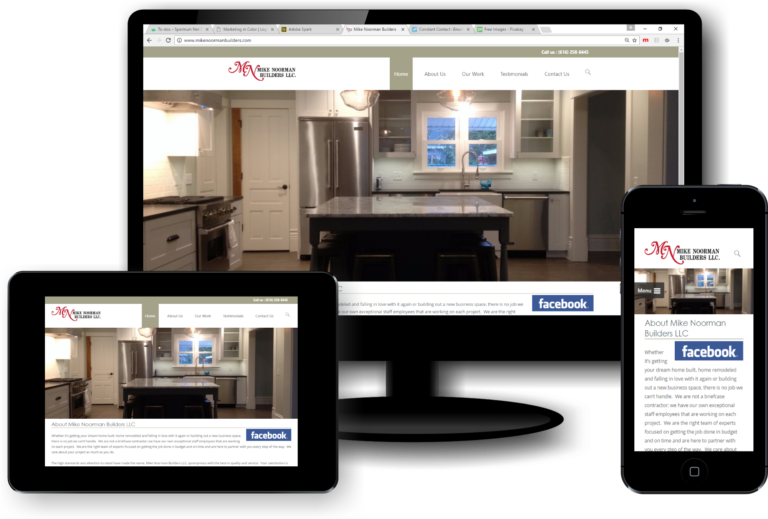
If your website has a poor mobile website appearance and navigation, then you are missing out on important traffic. Especially since Google will penalize you if your website is not mobile-friendly, which will lower your visibility on search engines. Mobile devices make up at least half of the global website traffic, meaning you should prioritize the mobile experience as much, if not more, than desktop performance. Having a mobile-friendly design doesn’t mean that you have to have a separate website; all you have to do is create a responsive web design, which will allow the site to scale and fit perfectly to mobile devices. Users are then able to have a perfect experience when using the mobile version. It will also make it easier when it comes to editing and updating content on the site, as it will adjust, making sure that it adjusts correctly for any device.

#2. Visuals Are Outdated or Unprofessional

The appearance of a website is essential to get viewers’ interest. Users often associate visuals and appearance with the quality of a business and the services it provides. So let’s make sure that first impression is a positive one. Outdated designs tend to make users think that you are behind, outdated, or not able to keep up with the trends. To come off as professional, you’ll need more than some text, hyperlinks, and images that are scaled improperly. Take a look at competitors and see what kind of design they have to offer. Check to see what kind of information they are providing, how modern their site is, and how they approach users. Don’t copy what your competitors have, but it’s a good idea to keep it in mind as an influence. When working on a redesign, gravitate towards designs that are modern and offer function, give users things to click on, read, and move through so that they don’t grow bored. You can also work with a web development and design agency to help bring your brand some new life. Spectrum Net Designs can help with that. We can help redesign your website to give it that new, modern, fresh feeling that will help you rank above your competitors.

#3. Business Goals Have Shifted

If your site is not helping to reach and accomplish your business goals by driving traffic or revenue, then it’s time for a redesign. Take a scroll through your website as you put yourself in the user’s shoes and see if it will answer the needs they have. No matter what kind of website you have, whether it’s informational, a non-profit, a business offering goods or services, always put goals ahead of design and functionality (not that you should ignore those aspects), so you can get your return on investment back. Make sure to keep everything consistent across different platforms. If your social media is presenting differently from the website, then it’s not sending a cohesive and consistent message, which can confuse current and potential users.

#4. Poor User Experience

Users are looking for sites that have quick loading times. If a website takes longer than 3 seconds, a little more than half of the users will leave and go find another site. This results in higher bounce rates, which affects traffic and visibility, ultimately affecting business and revenue. Slow load times can come from oversized images and videos, a large number of plugins on the site, and outdated hosting programs. Correcting these issues by optimizing images, removing or updating plugins, and changing or updating your host will help improve the user experience. If loading times are at an appropriate speed, the next step is to look at bounce rates from the site in general. If users are leaving the site after only seeing one page, then you might not be capturing the user’s attention enough, which leads them to bounce. Adding interactive elements and enticing users with attention-grabbing titles and content that is easy to navigate will help to improve the user experience.

#5. SEO Needs Improvements

If your website is not appearing at the top search results of search engines, that could mean that the site needs SEO improvements or that it isn’t optimized for SEO, meaning it isn’t at its full potential. SEO is necessary and the perfect way to reach current and potential customers. Without SEO, websites are practically invisible, and opportunities are being missed. Yet optimizing for keywords, making adjustments to site structure, improving site speed, and fixing broken links are all things that can turn it around. Although it can be explained simply, SEO is a long process to go through and requires research, analysis, and continuous adjustments. Instead of spending time on SEO responsibilities, Spectrum Net Designs can do it for you. We can take care of all marketing needs like content creation, web design, SEO services, and more! Give us a call today to learn more!

Website Redesign FAQ's

It’s suggested that you do one every 2-3 years to keep up with new technology, trends, competition, and user experience. It also depends on your brand and business, if you have changes or a shift within, then sooner would be better, since it’s a good idea to keep your users updated. If it is 5 years or more since you’ve had a redesign? You should take the time to redesign your website and create more opportunities for reaching users and ranking on Search Engines.

A refresh is making adjustments and updates to content, keywords, pictures, colors, etc. A redesign changes functions, structure, layout, and overall feel of the site. A redesign is a lot more intense and requires a lot more time than a refresh but it will leave you with a bigger more meaningful change.

If the redesign improved traffic, visibility, search engine rankings and decreased bounce rates then the redesign had a positive impact. Track your traffic so you can do a proper comparison and see where the changes were and specificall how much, this will help you continue growing and gaining.

Redesign FAQ's

Recent Blog Posts To Check Out!

Why is Website Security so Important?

website security

Why is Website Security So Important?

As technology continues to change, the challenge for businesses to keep their personal and customer information on the web secure continues to increase.

Web security is extremely important because it keeps hackers and cyber thieves from accessing sensitive information. By not having a proactive security strategy, businesses risk the spread and escalation of malware, and attacks on other websites, networks, and other IT infrastructures. Once a hacker is successful, the attacks can spread from computer to computer, making it difficult to find the origin.

How To Tell If a Website is Secure

There are many avenues you can take to tell if a website is secure, including implementing HTTPS on your website. In addition to HTTPS, you can also tell if a website is secure and trustworthy by asking yourself a couple of questions:

  • Is the website an established authority institution?
  • Does the site provide expert value?
  • Does the website look spammy or broken?
  • When I hover over links does the link look spammy?

Is Your Website Secure? Find out if your website has the proper SSL certification to be considered secure by Google. Check your website security here

How Can I Make My Information On The Web More Secure?

User awareness is the best line of defense on the web! Avoid the risk of web security attacks with these 5 security tips.

Use Strong Passwords

Before it was 3-to-4-character passwords that would keep your information the safest. However, as technology has advanced, so can crack passwords.

Now, the best practice for your password is to make it at least 8 characters with a mixture of lower case letters, capital letters, numbers, and a special character. Don’t make your password a familiar phrase. It might be easier to remember but a password cracking software can break that in no time. An idea is to take the first letter of a phrase you will remember and use, like this:

“I love my Dogs Charlie, Emma, and Drake” would be “ILm3d-cE&D”.

Also, remember to not use a password twice. If someone hacks into one of your accounts they could access your bank accounts, online purchasing accounts, and any other important information.

Always Use Secure Networks

When logging into financial or other personal websites, check the address bar before logging in to ensure it is secure. If the address starts with HTTPS, then you know it Is secure rather than not having the “S” at the end of HTTP. If it is HTTP, then you either have the wrong login page or it is possibly a spoof (fake) website.

You should never click on a link in an email that looks suspicious. You should actually never click on a link that comes from any personal website such as your bank. You’ll want to head straight to your bank website that you trust or give them a call regarding suspicious activity in your email.

Connect With Us

Facebook
Twitter
YouTube
Pinterest
LinkedIn
Instagram

Categories

Recent Posts

Archives

Use More Than One Email Address

You can make your personal banking email more secure if you use a different email for things like Facebook, Instagram, and even Amazon. If someone were to hack into one, then they would not automatically have access to all the others.

Be Cautious About Posting Your Email Address Online

This is asking for spam if nothing else, but it also opens a message of “Hey, hack me. Here’s my email address.” Avoid posting your email address on any forums, review sites, and messaging boards where spammers can easily access your address.

Are You Looking For Help With Your Website Security?

Website security is extremely important to protect your online identity, personal information & brand reputation. If you are concerned about the website security for your business, or other network issues, Spectrum Net Designs can help! Feel free to contact us to learn more about our affordable website solutions. We also provide website design services, marketing services, SEO services & so much more!

Learn More About What Our Team Can Help You Out With

Breaking Down Google Analytics Data and What It Means

Google Analytics Data and What It Means

Breaking Down Google Analytics Data and What It Means

Google Analytics provides powerful insights about your website’s users. But understanding isn’t all that straightforward for beginners, and that’s why we’re here! Let’s talk about what Google Analytics is, what it does, and what all wonderful reports it can tell you about your website visitors. 

What is Google Analytics

Google Analytics is a free tracking tool offered by Google, and it provides insight into the visitors who come to your website. You are capable of seeing the number of visitors on your site in real time, where they are coming from, and even which device they are accessing your site on, and so much more.

What Does Google Analytics Do?

Google Analytics offers its users information about the online behavior of their audience, which can be critical for your business. There are many reasons why you should be utilizing this free tool. It has many benefits, including:

Measures your website’s performance

Check if your marketing efforts are working

Which type of content should you create, or products should you list on your website

Divide your audience into segments based on age, gender, country, device, etc.

Optimize your web pages to boost conversions

Using the Reports

Once you have set up your account and added your tracking code, it’s time for the fun and to see exactly what Google Analytics can do for you.

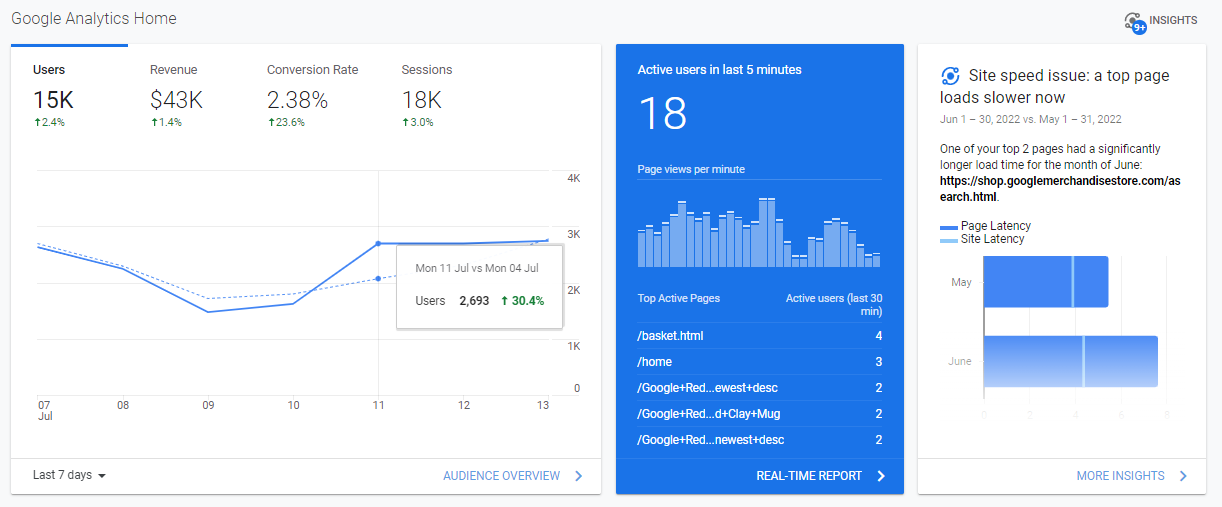
The first thing you’ll see is the Google Analytics home screen. This will give you a quick overview of how your website is performing.

Google Analytics Data and What It Means

In the above screen grab of the home screen, you’ll notice:

Users: how many visitors came to your website (in the past 7 days, in this example)

Sessions: how many interactions a visitor makes within your website within a period. Ex: viewing a page, clicking a link, or purchasing a product.

Bounce Rate: how many visitors hit the back button or close your website without performing an interaction.

Session Duration: the average amount of time a visitor spends on the website

Active Users Right Now: How many active users do you currently have on your website

Connect With Us

Facebook
Twitter
YouTube
Pinterest
LinkedIn
Instagram

Categories

Recent Posts

Archives

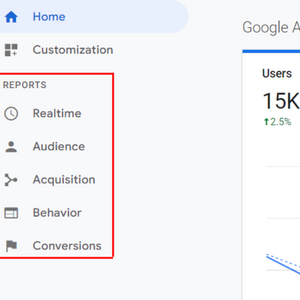
Left Column Google Analytics Reports

On the left side of the dashboard, you’ll find various reports. Each of these reports will provide insight into how a user interacts and behaves with your website.

Google Analytics Data and What It Means

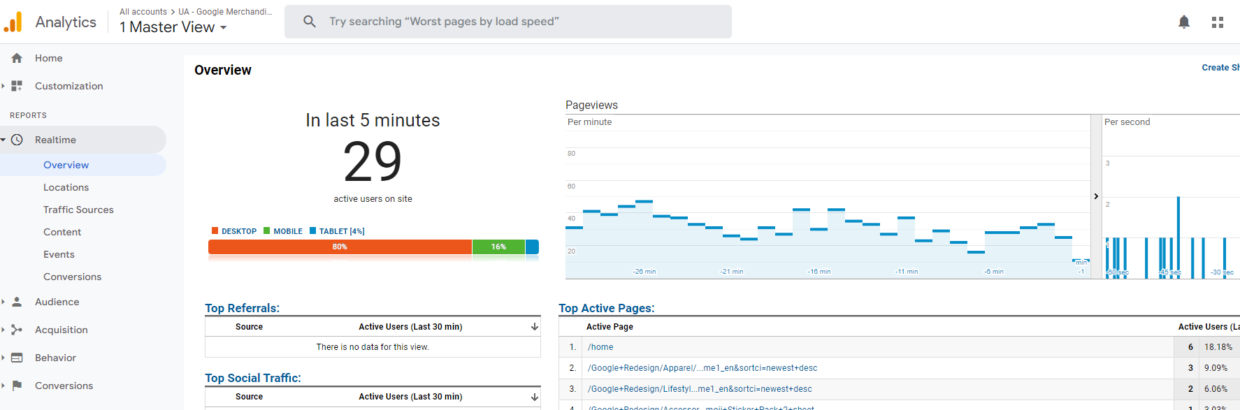
The Realtime Report

This report will show you the number of users currently on your site. This is the tab you go to when you want to see real-time activity on your website.

By clicking Overview, you can see the top active pages on your website, how many visitors are on each page, and the country they are from. The overview will show all the important information in one place. But you can also use the more options like traffic source, content, event, and location to get more insight about your real-time performance.

These reports are great for measuring the performance of recent campaigns that you are running.

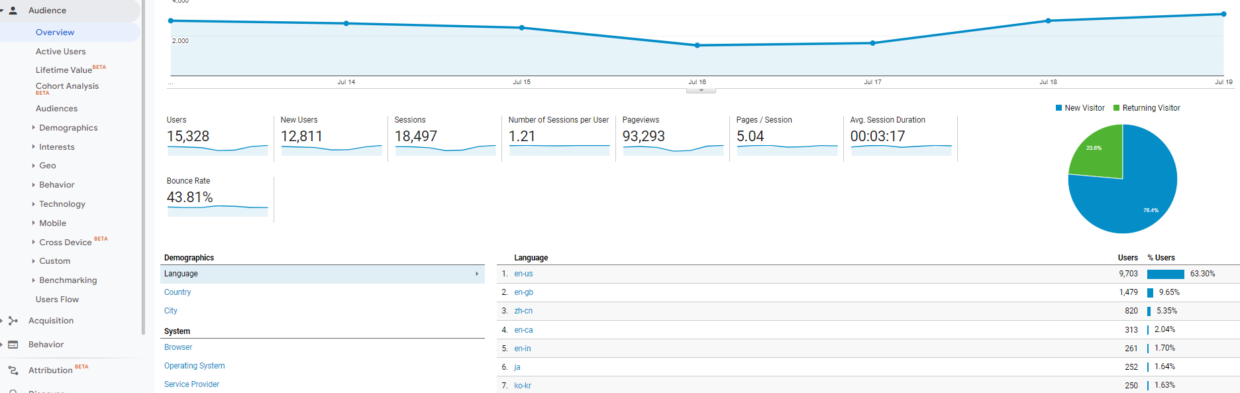
The Audience Report

This report in Google Analytics breaks down your website traffic. If you are interested in knowing the age of your visitors or the device they are using, this is where you would go. As you can see under Audience, more reports are easy to understand. You can gain better insight into demographics, geography, interests, etc. The mobile section will show you which device your visitors are using to view your website. This can be helpful information when deciding which pages to optimize. 

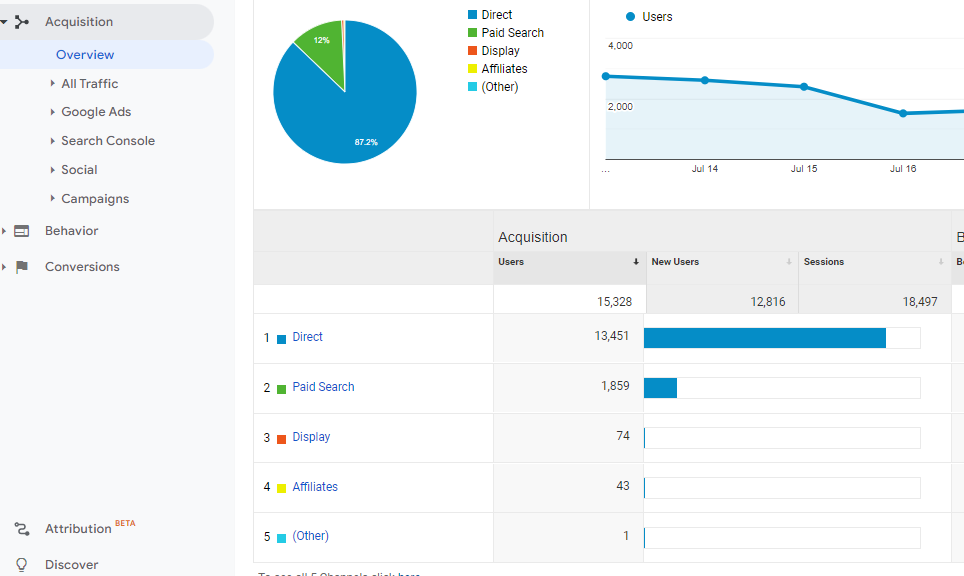
The Acquisition Report

First, starting with Google Analytics, the acquisition report will be very helpful. It will show you how the traffic reaches your website. Google Analytics divides these traffic sources into four categories:

Organic Search: users who come from search engines like Google or Bing

Direct: users who directly type your website into the browser, open your website through a bookmark, or when Google can’t recognize the traffic source.

Referral: users that come from any source other than search engines, like a link on another website or a YouTube video.

Social: users that arrive on your website from a social media platform like Facebook or Instagram.

The Behavior Report

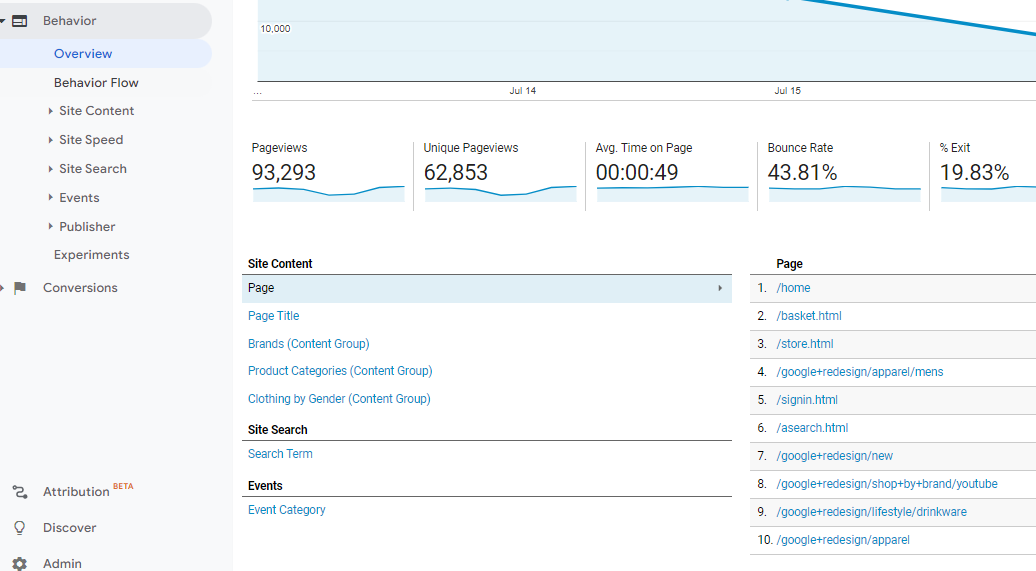
If you are interested in finding out what your users are doing on your website, this is the report you would go to. In its Overview, it will show you a snapshot of your user’s behavior:

Pageviews: the total number of pages viewed by your visitors

Unique Pageviews: This is when an individual has viewed a certain page at least once

Average Time on a Page: It’s the average amount of time a visitor spends on your website

Bounce Rate: the percentage of visitors who only view one page and then leave without interacting with it

Percentage Exit: How often visitors exit your website’s pages

The Conversion Report

Lastly, the conversion report tells you how your website’s conversion rate is performing.

What is a conversion rate? It is simply any activity completed by a visitor.

This report can get a little confusing for beginners. It requires advanced setups like creating a goal in Google Analytics or setting up eCommerce tracking. To understand how this works, here’s an overview of two reports that might be useful to you: Goals and Ecommerce.

Under Goals, you can go to Overview and see the total goal completions on your website, like visitors placing a bid. It will also show you the location where your goals are completed the most.

If you are running an online store, then the eCommerce section is important for you. It will provide you with individual product performance, sales performance, order size, and time of purchase. All of these metrics should be important to you to help improve your online sales and boost conversions.

Since there is additional setup for the conversion report, there’s an easier way to collect this data. You can simply install a WordPress plugin called MonsterInsights that will allow you to track your store’s performance without the manual setup.

MonsterInsights Reports- a Quick Overview

The MonsterInsights plugin is one of the most user-friendly Google Analytics plugins for WordPress. It enables anyone to install and use Google Analytics in WordPress easily, without any daunting code. MonterInsights offers a variety of reports that make reading Google Analytics very easy.

All of these metrics are useful to learn more about your users and to help improve your marketing strategies, SEO, and boost your conversions. Now you are ready to make a Google Analytics account, if you don’t already have one, and start leveraging the information to improve your own marketing strategy! 

If you are looking for some help with your current marketing needs, feel free to reach out to the Spectrum Net Designs Team! We’d be happy to see if there’s an opportunity to get more out of your current strategy! 

Why Choose WordPress Over Other CMS Platforms?

Why WordPress

Why Choose WordPress Over Other CMS Platforms?

Beginning out, WordPress was a well-known blogging platform. Now, not only used for blogging, it is a great content management system (CMS) to consider for your business website. There are other free and paid CMS options out there, but WordPress solutions can help improve your users’ online experience while answering your company’s need for website control, flexibility, and ease of use.

We have created a list of reasons why WordPress is a great avenue for your website.

WordPress is free for anyone to download, and it is an open-source platform that has been around since 2003. Open-source platforms typically offer free services, with large communities. The users will take part in the community as beta testers or simple brand advocates, but there are no real requirements for participation if you don’t want to.

Keep in mind: even though the software is free, you will most likely have to spend some money on hosting and advanced plugins. Their hosting fee starts around $3/month, for the cheaper shared servers, and can go all the way to a couple of hundred/ month for those needing ultimate speed and performance.

You can find themes and plugins for free, but the premium (paid) ones will provide better features and quality support. Many users resort to paying for additional services, whether it be from freelancers or agencies. Ultimately, you can keep your WordPress costs to a minimum by using the free plugins and themes and going with their hosting program. 

Flexible to Make any Type of Website

I’m sure you have heard before that WordPress is mainly for building blogs, but this is not true. At one point in time, this was the case, but over the years and many releases, they have changed their offerings and web design solutions. WordPress is at a competitive advantage with its blogging history. It has one of the cleanest and fastest ways to write and publish pages and posts, and that’s all included from the start.

Websites that you can create with WordPress:

  • Blogs
  • Business Websites
  • Portfolios
  • Forums
  • Ecommerce Sites
  • Ratings Websites
  • Membership Sites
  • Personal Websites for Self-Promotion
  • Job Boards
  • Non-profit Websites for Collecting Donations
  • Auction and Coupon Sites

And the list goes on! The advantage of WordPress is that the functionality for features like forums and e-commerce websites is achieved with simple plugins and themes.

Supports a Variety of Media Types

Another advantage of WordPress sites is the long list of accepted file types, these are the primary categories that are all accepted:

  • Images
  • Documents
  • Audio
  • Video

You can upload common files like .jpg, .png, .gif, .pdf, .doc, .pptx, .mp3, .m4a, .mp4, .avi, and more. You will not have any problems with more obscure file types like .odt, .key, .ogg, and .3pg.

Keep in mind: WordPress does support pretty much any type of media. However, don’t forget to follow the rules and only use legal media that is either owned by you, has free downloads, or you can use when given credit. Some places to find legal photos and videos are:

Big Community & Easy to Learn

Since WordPress is open-source software, it can be used by anyone. Their user base is not limited by pricing, premium customer support, or even a user’s skill level. Since there aren’t many roadblocks to accessing the software. Users have made blogs, forums, online courses, seminars, webinars, and even books, all outlining aspects of the WordPress platform. And there is always the option of paying for more official dedicated support or working through those forums and online courses.

Why WordPress

Customizable Plugins & Themes to Scale Up and Expand Your Website

As mentioned before, WordPress themes and plugins make it easy to construct your website, but those elements are essential for scaling up your personalized site. For a blog, you will install a theme, adjust any design features you’d like, and then start writing your blog. The same goes for other business websites or portfolios. Your chosen themes will serve as your site’s foundation. The design work will become minimal besides color changes, adding your logo, and the creation of new pages and posts.

You will realize that additions to your site will need to be made. Maybe you want to include your social media profile streams in your footer or add a membership section to your site. Those will be successfully executed with a variety of plugins accessible to you. There are hundreds of plugins that are available to you. To learn more, check out our free eBook The Ultimate WordPress Guide to Relevant Plugins.  

Expanding your site isn’t solely accomplished with plugins, you might find yourself needing a new theme. Yes, plugins typically can run the show when it comes to adding functionality to your site. Most of the time, you’ll only need one theme once you launch your site. But as everything grows, you’ll notice you want different functionalities and needs, along with changes within the industry. An example of this was when Google started rewarding mobile responsive websites. Once that was enforced, many developers started offering mobile-friendly designs. Therefore, owners of websites needed to switch their themes to ones that offered mobile-friendly designs.

Other desired themes for growing websites are for the following reasons:

  • A needed switch from a free theme to a premium one
  • Wanting a fresher look
  • Wanting better customer support
  • A shift in product offering

Easy to Manage

WordPress is not all that difficult to manage if you learn the ropes and go through some training courses. Some website management typically involves a couple of things:

  • Checking and making sure your server is performing
  • Keeping up with your security
  • Running backups of your site
  • Keeping your plugins up to date and the WordPress software
  • Managing spam
  • Fixing broken links and testing the site’s functionality
  • Improving SEO and making page speed improvements

SEO Comes First

A great advantage of WordPress is that SEO is built into the platform. WordPress will automatically generate title tags and meta descriptions for your pages and posts. Implementing title tags and meta descriptions allows search engines to understand your content better, and will get your pages/posts indexed and ranking higher.

The Yost SEO Plugin is a favorite amongst SEO experts that helps them take their rankings and mobile responsiveness to the next level. The Yost analysis shares how effective you are at targeting your keyword. You’ll see insight on keyword density, where to add more keywords, SEO title mentions, page title suggestions, meta suggestions, and more. It’s a great checklist for you to make sure you are ticking all the boxes for SEO optimization.

dominate local seo

Joining WordPress doesn’t require users to sacrifice much to test the waters. It’s a free, open-source software that is easy to use and comes with numerous resources for insight on how to build a successful website. Tons of plugins allow you to create a website that functions for your specific audience, and not to mention make it mobile-friendly.

If you are looking for help with your website, contact Spectrum Net Designs today OR check out our WordPress portfolio to give you some inspiration!

Connect With Us

Facebook
Twitter
YouTube
Pinterest
LinkedIn
Instagram

Categories

Recent Posts

Archives

How to Create a Landing Page for Your Business

Landing Page

How to Create a Landing Page for Your Business

A landing page is a frequently used marketing term for the first page a user lands on when they click on a link from an external source, such as an advertisement or SERP listing. They click the link, and it will take them to a specifically created page with the intent of getting them to take action.

The main objective for any business is to get their online users to then make a conversion, such as purchasing a product or filling out an inquiry form.

A landing page should grab the users’ attention and be easy to navigate. It needs to encourage and tell the visitor exactly what they should do next and allow the call-to-action to be very obvious. Customers who are engaged with your message and want to contact you can still exit your page if the contact form is not easy to find or confusing with too many questions.

Elements for the perfect landing page

We will highlight some key elements to include and how to include them to create the perfect landing page that will increase the average session duration and maximize conversions! Creating a strategic landing page is such an advantageous way for any sized company to showcase their products/ services to users, faster!

Engaging Headers

One of the first things your users’ eyes will focus on is your header. Your landing page should have a clear and engaging header that is visible and legible. The header should be short but catchy and explain your unique selling point for the product or service you are offering. It is useful to include a sub-header to expand on your headline that provides more insight into what you intend to do on the landing page and more about your business.

landing page

Include Various Forms of Media

Many online users prefer to learn and interpret things visually in this modern day. No one wants to see a web page with just clumps of text and no visual elements. Therefore, when you are creating the perfect landing page, incorporating imagery or video into the design is a critical step. Allow your media to help tell your story and intrigue your users to convert.

If you use a video, it should be short, to the point, and engaging. It should represent what the landing page is about and tell a story from start to finish. Above anything else, the video should add value to your landing page. If the video is too long, it will deter the user’s attention span and could potentially affect your SEO if it does not load properly or put a strain on the web page loading time due to its size.

The same rules apply to the imagery you choose for your landing page. It needs to be relevant and look fitting wherever you place it. Place your images on the side of text or as a banner, that choice is up to you and what looks the most appealing to your eye. Images need to be clean, and the correct size, as larger images can affect your page load time.

Don’t forget to apply the correct image SEO practices as well! You will need to optimize these images by providing the proper file/image size, relevant names for your image, and alt tags and captions.

Logo, Branding, and Colors

Consistency throughout your web pages is an important element to remember. The web design should be similar in terms of your logo placement and branding. Especially with high traffic and high converting pages, you will want to place your logo somewhere very noticeable. This will help increase brand awareness for the future. Your logo should be placed strategically and branding should be consistent. This will aid in a more appealing page for visitors and more interesting to the eye.

When considering your target audience and who you want to create conversions and reach around for your landing page it Is important to consider color palettes and schemas along with text font.

Call-to-Actions and Conversion Points

CTAs are powerful tactics used for conversion rate optimization. They steer users in the right direction to perform a specific action. A call to action can be something as easy as, “Contact Us Today for a Free Audit.” Incorporating CTAs across your landing page and directing the visitor where to go to contact or purchase will maximize your conversion rate optimization. Just remember to not bombard your visitors with too many CTAs.

Conversion points are elements such as buttons and inquiry forms that a user can fill out or click to contact, buy, or inquire about your service/product. These conversion points should be big and visible on the landing page. How you integrate the conversion points is up to your personal preference and audience, but as long as they are visible and accessible that is all that matters.

landing page

These discussed elements are some of the most important things to consider when building a landing page. They will enhance encouragement to your visitors to take action and be even more interested in your business than before they landed on your page.

Looking to Create Your Very Own Business Website? Check Out Our Website Development Solutions!

Connect With Us

Facebook
Twitter
YouTube
Pinterest
LinkedIn
Instagram

Categories

Recent Posts

Archives

Is Your Site Mobile Responsive for 2019 Web Traffic?

Why This Should Be A Priority....

Do you have a phone? How about a tablet? Nearly everyone in today’s day and age carry around a smart phone and have some sort of tablet. The mobile device is always near them throughout the whole day. This kind of lifestyle is predicted not to change. People use their mobile device for everything: communication, searches, social media, etc.  Maybe too much reliance on mobile devices will have irreversible affects, but for now website owners are recognizing this direction of technology, and are frantically trying to catch up. The new year is upon us and coming quickly, and we want you prepared for the new 2019 web traffic that will be coming your way.

So I just have one question, is your site mobile responsive?

What is a Mobile Responsive Site?

Today, phones, tablets, and desktops are all made in different sizes. Website designs need to change and adapt fluidly to whatever screen it is appearing on. A responsive website is one that changes based on the needs of the users and the device they are viewing the site on. For example, a website with a three-column layout would change to a single column display on a phone.

Some key features for a mobile responsive site include:

  1. Dynamic content that changes
  2. Navigation is condensed
  3. Optimized images
  4. Correct padding and spacing
  5. Relies on mobile operating systems to function
site mobile responsive

What is the difference between a Mobile Responsive Site and Mobile Friendly Site?

mobile friendly devices

A mobile friendly site is one that is designed to work the same exact way across all devices. It has no changes. Features are limited, and can be very difficult to use on mobile devices. A Mobile Responsive Site is a bit different, a mobile responsive site automatically adjusts sizing, layouts, and features based on the device it is being used on. This design provides a better user experience by providing easy-to-read text and easy-to-use features.

So, why should having a Mobile Responsive Site be a priority?

It has been proven over and over again by several different independent organizations through extensive testing that Google has updated their algorithm, but that is nothing new, but now Google favors websites that provide mobile users with a responsive and favorable experience.  This is huge to ranking factors and what business owners are currently implementing.  This should be a concern to businesses that thrive on selling products online. Mobile traffic in 2017 was 52.64%, meaning, more internet usage is through mobile devices than a desktop. By the end of 2018, it is predicted that mobile devices will reach 79% of internet usage over desktop. This is why it is so necessary for having a mobile responsive site.

If you do not have a mobile responsive site, you are losing website traffic, and therefore, potential customers and clients. 

site mobile responsive

Blog Management is More Than Content Writing

blog management

Blog Management Content Writing

We all know that blogs are important for a website. Blogs should be one of the first priorities of your company’s marketing strategy.  They help your site gain more traffic, increase your site’s search engine rankings, help communicate to potential and existing customers, and more! (Check out our past blog to learn what that more is!) Bottom line, blogs help you get found online. Blog management is essential for sites that want to rank high in Google and want more traffic. Many companies are starting blogs and posting content, so why aren’t you? 

blog management

 It’s true, some companies don’t have time to write blogs. They take time and energy that most people can’t spare. If they do have time, most don’t know what to write about. So how do businesses make it work? They have blog management. The key to great blogging is to write content that complements your vision of your business. 
But did you know that blog management is more than just content writing?

What is blog management and what do blog managers do?

1.

The blog manager’s goal is to ensure the company is gaining the best result with traffic and ROI from the blog. So before the blog manager even begins writing, they need ideas on what to write about. They lead brainstorming sessions, research, and pick a specific target audience to make sure the result of the blog reaches its full potential.

2.

How can the blog manager be sure the blog is reaching its full potential? There are certain practices to make sure the blog has good search engine optimization. Formatting, readability, graphics, links, calls-to-action, headings, and more. Whoever is managing the blog checks and re-checks all these practices. Not to mention editing, proofing, and rewriting content! 

3.

4.

An important detail for blog management is scheduling. A blog calendar is very important for websites that have blogs being published daily, weekly, and even monthly. Google and/or Bing like to see a site that is updated regularly, whether that be daily, weekly, or monthly. The manager schedules and has ideas for blogs months before they are published.   For certain companies, seasonal blogs are important, while other companies have a certain time of day when the blog would get the most traffic. The blog manager knows all these things, and schedules accordingly. Each platform also has specific high ranking posting times, discovered from years of back data, that is extremely helpful for beginner bloggers and social media marketers.

The last, but maybe the most important thing, is what blog managers do once the blog is published. A certain amount of time after the blog is published, the blog manager analyzes the results. This is how they know if the blogs are helping and living up to their potential. If the blogs are not, the blog manager fixes the problem.  You can also take the approach beforehand and navigate away from issues with A/B Testing methods. 

As you can see, blog management is more than just content writing. It ensures that the blogs are living up to their potential and that you are receiving the best results with site traffic and sales due to the blog. Try managing your blog with a scheduling program to help you out and save time.

Quote

Do You Need Help Starting or Managing a Blog?

Contact us today! We will work with you to create a blog customized to your brand. We can produce content related to your specific industry and publish with or without assistance from your company. We know you’re busy, and we have years of industry knowledge to put to work for you.  

It is known that “the more, the merrier,” and that also goes for blog posts.  A minimum of 2 posts should be published each month to keep traffic flowing and provide fresh content to keep the search engines happy.  If there is not a blog currently on your website, we can set one up for your company.  Contact Shannan at 866.773.2638 or email her at Shannan@spectrumnetdesigns.com.

are you stuck - content writing services

Website Misconceptions 101

Web Design Mistakes & Misconceptions

Welcome to website Misconceptions 101, where what you think is really isn’t, and probably vice versa.  Did that make sense? Some website misconceptions are fairly cut and dry and have never been an actual method used but some think they are still effective. Many of the “old” techniques and methods that used to be “the only way” things were done are now actually misunderstood and no longer relevant. 

Below are the 18 most common website misconceptions in 2018, that all users should be aware of when building a website.  From end user design, functionality, formatting, and more you need to know!

1. But users don't scroll below the fold anymore..

False! Users scroll more than ever now. In this era of phones, tablets, and other mobile devices, people scroll constantly. It’s as simple as moving a finger or thumb over their screens. While this might have been a problem in the past, it is not as important now.

Nowadays, when someone talks about “above the fold,” it is more about the importance that whatever is up there is convincing enough to keep the visitor on the site. Even if it is just below the fold, you are fine. It’s more about keeping the important information at the top.  You want the user to scroll, click, and spend as much time on your site as possible for SEO purposes.


2. Anyone can make a website using generic "drag and drop" systems....

False! Sure, you can try, and it might work for smaller less technical websites. But it’s more relevant that you will run into issues such as formatting, cross browser compatibility, and more issues that can run from simple to super technical. Some features you may want will not be easily obtained, if you need custom form fields or other custom needs. Therefore, designing your own site would be difficult but not impossible when you don’t have a lot of tools and features available.


3. I can just go to Google for an image and take anything I find.....

False! You should assume any images on the web, including Google images or any images on a search engine, are protected by copyright law.  It is considered illegal to use an image that holds copyright without the owner’s permission or without purchasing a license that gives permission. What you want to use is royalty free images on sites such as www.istockphoto.com or www.shutterstock.com where you can purchase images with full or partial rights for your website and print needs.  Other images you can utilize are free creative common images such as Pexels or Pixabay.  But be aware that many people use those sites and the images can be used all over the place so they will not be unique to your site.

4. My site is only 12 years old and still like new...

False! Website design and development has changed dramatically in the past few years. Website development changes every year, so keeping up with the latest is like keeping up with the Kardashians.  There have been many advancements including responsive development and mobile design, website elements, structure, and formatting. Not to mention Search Engine Optimization, which constantly changes with Google standards and processes. If you do not update your site, your website will go stagnant and will be lost in the search engines.  A website that isn’t updated is similar to a blank piece of paper flying in the wind. So take care of that site with regular maintenance and fresh content every few months. 


5. Duplicate text doesn't matter, I'll just copy from my competition....

False! People used to be able to get away with this until Google and duplicate content standards came along. Now, there are a few reasons you cannot duplicate content or copy content from other sites.  You risk your site being considered spam and have the risk of getting a bad ranking and being penalized by the search engines for just a few reasons.  Google and other search engines use tools that measure sites for 100 different points, and they base ranking on it.  So be original and post unique content for the best outcome possible. 

6. The more empty space, the cleaner my site will be....

False!…well, kind of Let’s discuss this, if you have too much empty space, there won’t be enough data and content for users to find what they are looking for. Yet if you have too much data and content, your site can look cramped and you overload your clients with too much information. What you need to do is find the perfect balance of clean and yet still give important information so that the users want to stay. You can obtain this by adding new pages with specific content, organizing your information for easy to find content, and only posting useful information.


7. The bigger the better?​

This can go both ways.  The question is, where do you want customers to be directed to on the site? An over-sized logo can take the focus away from your content.  On your site, you need to have a clear focus on what you want your site to be about and where you want your customers to go.  For example, if you have an oversized logo, the proportions will be all out of balance. Try to make things big enough so your users can see what they are looking at, but keep the proportions even and balanced.

8. All browsers are the same, does it matter what one I use....

False! Make sure that your site can be viewed on all browsers.  Browser compatibility is the flexibility of a website to function on different web browsers. The benefit of creating a website with browser compatibility is that it improves the traffic flow on a website and cuts down on loss of performance. So how do you make your site compatible? Keeping it simple, validating your code, testing in as many browsers as possible, and more. 

Need help? Call Spectrum Net Designs today!

9. I don't need any optimization; the website is on the internet and it will do it's "thing" and we will get millions of visitors. Here comes the traffic!

False! Without proper search engine optimization, the website will be just loose paper in the wind. It needs structure and architecture. Having SEO on a website will help Google, Bing, and other search engines find your site and rank it. Using Google services like Google Maps, webmaster, and analytics will also help you be found and increase your traffic. Also, adding fresh content regularly will also help. But doing nothing and letting the internet just “do its thing” will get you nowhere. 

10. Once I buy my domain, it's mine forever....

False! When you purchase your domain, you have yearly options to choose from including 2 years, 5 years, and ten years options. An important note is to write down all your expirations for hosting, domains, certificates, etc. File them somewhere safe. If you would like, you can auto renew many items so you don’t lose them. If you are looking for a new domain you can visit Godaddy, Network Solutions, or Register.com to name a few. 

11. Designers don't know best - the customer is always right!

While the customer knows their business, the web designer knows websites and what works best. All the client has to do is trust us, and they will be very impressed with the result. Still, while the web designer gives direction to the project and website, we listen to the client to see what they want and need. Every website and customer is different, and that’s what makes the development of websites so challenging yet interesting.

12. I only launched a month ago, all of my changes should be free..

False! Once launched, the site is now completed from the original quoted project and cost. After the launch of your new website, all changes to the site will be billed hourly or will need to be quoted unless prior arrangements were made or maintenance was included in your original quote. We have to pay our developers and designers, and you have to pay for the changes.


13. My website should be all about me and my company, not my clients....

False! Your website is for your clients! It needs to be about your clients and their needs. What do your clients want to see when they open your website? That should be the main focus of your site. Yes, some of the site is dedicated to your company, such as the “About Us” page.

Many websites have staff pages with bios and company pages with newsletters. But remember, the website is for your client to learn more about you and use your services.

grand rapids seo
website misconceptions

14. The site is completed, and I'll never need maintenance...

False! Too many people think website maintenance is out of date. It is the complete opposite. Without website maintenance, your site will fall into the abyss. Many things on your site need to stay updated: pages, content, blogs, pictures, etc. for Google to keep ranking your website. 


Do you need help maintaining your website? Give us a call! We’d be happy to help!

15. I have 20+ pages of content so the more content the merrier....

True & False! This kind of depends on the industry, but in general this is not true. The content needs to be organized and categorized by page and sub-pages. There is such a thing as too much information. You want to give your customers enough information to understand but not too much that they won’t call you. Keep some information for PDFs, printables, emails, and phone conversations. It is good to keep the client inquiring about what you’re selling. If you give them too much information right away, they will skip it and move on.

16. I don't need this fancy layout - web design is cut and dry text....

False! Humans are visual beings. You don’t need a super fancy layout, but you do need visuals on your website.  As long as the layout is organized, has layout consistency, professional appearance, balance, simplicity, and more, the web design has a good structure to buildonf in the future. Some might call this fancy, but depending on your industry, this appeals to the values and motivations of your targets. By appealing to your targets, you can create a final design product that is appealing to a broader audience beyond what you find engaging. 


17. All of the whitespace on my site needs to be filled, otherwise it will look empty and no one will visit my site.....

False! The most profitable and overall successful web design decisions are those made with justifiable evidence of your target audience’s interests, tastes, and end goals. Don’t make assumptions as to what your target audience wants to see; rather, try creating target profiles, or fictional personas, to frame your website designs around. Sometimes less is more and the white-space will work in your favor. Again, a balance between content and images is key.

18. It's my site so I should get final say!

True! But we have seen the results of this event, and we do not recommend it. Flashy animation, crazy color pallets, loud music in the background, trust us, we have seen it all. While you know your industry, we know ours. We know what works and what doesn’t.

We know it’s a lot, and it can be hard to keep track of a website. 

Lucky for you we are here to help!

  Give us a call or contact us and we would be happy to help you!

Top 5 Reasons Blogs are Beneficial for Your Website

Why Does My Website Need A Blog

You, as a business owner, have probably thought about doing a blog, and we are here to show you how blogging helps SEO! The idea may have crossed your mind, but then quickly left for the following reasons: First, a blog is work. Even if it’s just a couple of paragraphs a month, it takes effort and concentration. Secondly, a blog is time-consuming. You have to come up with an idea and somehow put that idea into words. Not to mention then you have to actually put it on your website. Who has time for all that? Lastly, what’s the point? It’s not like anyone is going to read it….right?

While a blog can take time and effort, the impact a blog can make is worth it. It sounds crazy, but blogs are what make a site known to the public. Blogs are beneficial. How? Blogs impact your SEO big time. Your site can fly up the ranks even if you post a blog every couple months or so. Here are some reasons why your blog can make a difference to your site traffic and ranking.

Fresh Content

One of the main things that search engines look for is fresh content. Your website’s pages probably don’t change that often. This is why a blog can make a world of difference. You will be steadily adding new, unique content at your own rate. When a search is performed by a user, search engines will pull the freshest and most relevant content to the top. Having regular updates and posts signals to search engines that a site is being active and updated regularly. This encourages them to crawl the site more often, which can lead to quicker indexing. By blogging, you put yourself out there as an expert in your specific field.

Popularity

Popularity

As your blog gets more traffic, it is constantly clicked on and shared. This will help it move up in search engine rankings. If you provide good, quality content, your readers will want to share it with others. How do you provide good, quality content? Be unique, provide answers, and share your blog as much as you can. Social media and backlinks will help spread the word and act as endorsements of your content if you’re offering quality information. With more popularity, you also get the attention of search engines, showing that your blog is offering trustworthy information, which people are gravitating towards. 

Backlinking

When other people link to your blog, that helps your ranking immensely. It creates an opportunity for getting pages indexed quicker. Search engines crawl backlinks for new content, which could improve your chances of getting indexed and more visible quickly. Make sure that you are linking with good quality sites; otherwise, Google will notice, and penalties will be applied. Use backlinks as a way to build relationships with similar companies; this will help you both provide different avenues for more people to discover the information. 

Backlinks

Social Media

If you connect your blog to social media like Facebook, Twitter, and other accounts, Google will notice and take that into account when ranking. It is a great way to drive traffic and feed the information to more people. Social media will also allow you to grow brand recognition and create a name for yourself.  Also, social media is a great way to get your company and business out there, especially for local SEO. Using social media and adding on local hashtags, locations, and other local businesses will open up more people to your posts. 

Indexed Pages

One of the most important reasons to have a blog is the fact that each post counts as a new page on your site. For Google to index a page, the page needs to be at least 300 words, preferably more. Reblogging, short posts, and duplicate content will not help when you want to boost your SEO.

Indexed Pages

For all these reasons and more, you can see how blogging helps SEO and is essential for ranking high in Google. According to Hubspot, having a blog will increase your website traffic by 55% to those sites that do not have a blog. This is why so many companies are starting blogs and posting their content.

Don’t have time? Have writer’s block?

Let us help you! Spectrum Net Designs can take care of your blog to help boost your SEO!

Give Us A Call Today!

Website Maintenance: Is Your Website Healthy?

Website health

Website Maintenance: Is Your Website Healthy?

Are you one of those very fortunate people who are as “healthy as a horse” and never have to see a doctor?

Yet…you still need essentials, such as food, water, and sleep, to keep functioning well.

So does your website!

It is a widespread, mistaken belief that once your website is up and running… it will stay that way. Forever. There is no need to do anything more – just let it go and let the conversions roll in. But…just as your health depends on the necessary essentials of food, water, and sleep, your website is also in need of various fundamentals as well in order to remain a viable means of promoting your business and increasing your bottom line.

It is a well-known fact that the best way to stay healthy is through what is known as “preventative health maintenance”. According to Lacie Glover:

“Catching and treating a health problem before symptoms start, or better yet, preventing a sickness entirely, isn’t just good for your health; it can also save you some serious money down the road.”

After all, what’s worse?

A tetanus shot…or a locked jaw?

The MMR vaccination…or the measles?

Blood pressure screening…or a stroke?

An aspirin a day…or a heart attack?

A mammogram…or breast cancer?

The list for preventative care goes on and on. Your continued health could depend on catching and treating a serious or chronic condition before symptoms appear. And, as stated above, could save you a boatload of money as well.

Website health

And just as preventative health maintenance could mean the difference between remaining healthy or being sick, so can website maintenance mean the difference between a well-functioning website and one that could, in the end, cost you money.

In today’s age of “googling”, your website is your face to the world. It is where you have the opportunity to make a great first impression on potential customers. However, if your website is “sick”…would you want to stay?

Is the content stale? 

Is it loading properly?

Is it running too slow?

Does it have bad links?

Are the graphics out-of-date?

Is it functioning well on mobile devices?

All of these, as well as many more, could be reason enough for your users to bounce off your site…for good.

Or consider…does it have a virus? Has it been hacked?

In The Cost of Website Ownership: “Do You Do Your Own Brake Job Joshua Conran quotes this statistic: “83% of hacked WordPress blogs are not upgraded.”

Is this sufficient reason to be convinced that your website needs preventative maintenance? Or are you just going to wait until symptoms appear?

Some “healthy” people do exactly that. Not only do they wait until they experience symptoms, they ignore them when they do appear until it’s impossible not to. Even then, they may just try to treat them themselves, completely overlooking the warning signs of a more serious underlying problem.

Does this bring anyone to mind? Maybe you?

By the time they finally do make it to the doctor, it is not only going to take longer to heal the infection, ailment, or virus, but it is also going to take more time and money. And if worse comes to worse, it may no longer be possible to cure.

Not a good outcome…at all.

Are you convinced? Does your website need maintenance? If the “health” of your website is negatively affecting your users’ experience or causing grave security issues, then you need to consider it. If so, what does this “preventative” maintenance entail?

Healthy Website Maintenance

  •  Platform Upgrades
  • Security Updates
  • SEO Updates
  • Plug-in Updates
  • Browser Updates
  • System Updates
  • Code Updates
  • Software Updates
  • Anti-Virus Patches
  • Mobile Functionality
  • Content Maintenance
  • Website Speed
  • Website Backup
  • Link Check

All in all, you want your website to be secure…and give your users a good experience.

Once you’ve decided that your website needs maintenance in order to remain healthy, viable, and profitable, who do you go to?

Do you try to take care of these issues yourself? Maybe you are tech-savvy enough to do the code and system updates. Maybe you have the time to take away from your business responsibilities and obligations to write new, fresh content as well as optimizing it for the search engines as well as making it appealing enough to grab your users’ attention. But are you able to make eye-catching graphics with a unique design and ensure your site is secure as well?

If you are not one of those individuals who is an expert jack-of-all-trades and has the time available to take care of everything that is required and essential in maintaining a healthy website, then where do you go?

If you were sick and need a doctor, whom do you go to? Do you choose a physician who still thinks that the latest medical technology is a digital thermometer? Or one that is up on the latest and greatest medical advances and research in addition to technology?

At this point, you probably have determined the answer to the question. If not, or if you have further questions, ask us! We’re more than happy to help you! Or, check out some easy monthly website maintenance tips here.

If you google “preventive health maintenance”, you get hundreds of results from Wikipedia to a prestigious organization such as the Cleveland Clinic. They all agree…preventative health maintenance is imperative.

For children, yearly check-ups are vital. As kids grow older, these visits become less and less and some, no, many in their twenties and thirties opt out of having any preventative care at all. Instead, they choose to play roulette with their health – assuming that bad health issues are for the next person…not them.

Are you playing roulette with your website’s health? Hazardous viruses and security issues are for the next website, not yours?

Are you willing to risk it?

Finally, consider this revision of Lacie Glover’s quote:

“Catching and treating a website issue before problems start, or better yet, preventing a breakdown entirely, isn’t just good for your business, it can also save you some serious money down the road.”